
Scientific Guessing vs. Blind Flukes: What is the Difference?
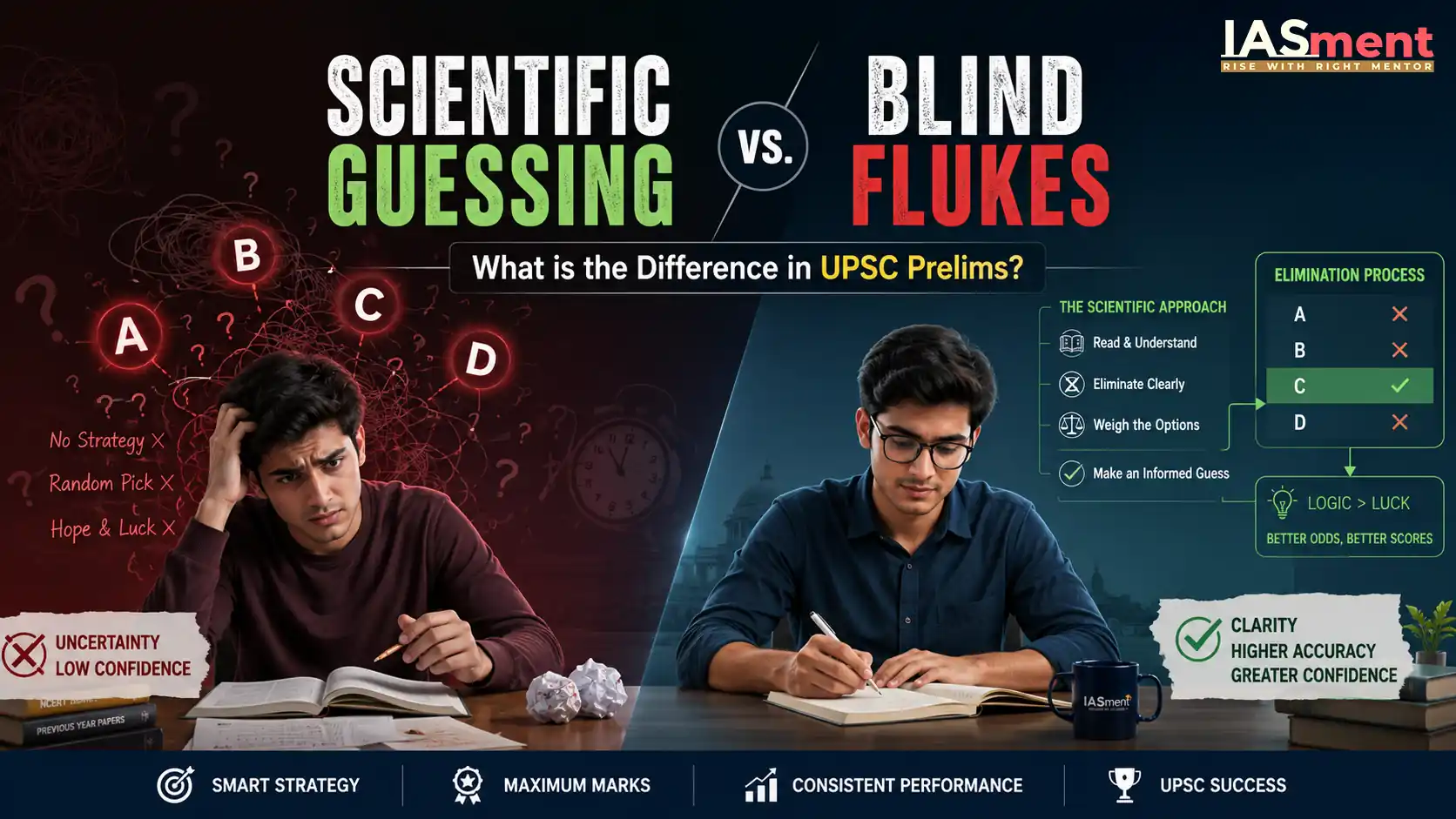
Scientific Guessing UPSC Prelims is one of the most misunderstood ideas in Prelims preparation.
Many students think that every guess is a fluke. They believe that if they are not 100% sure, they should either leave the question or mark an answer randomly.
Both approaches are dangerous.
There is a major difference between blind guessing and scientific guessing. Blind guessing is emotional. Scientific guessing is trained, logical, disciplined and based on elimination.
UPSC Prelims does not always give complete certainty. Many questions are designed to test how a student handles partial knowledge, confusing options and hidden traps.
That is why a serious aspirant must understand this clearly:
At IASment, Aayush Sir teaches this as part of the Prelims Techniques Training Lab because UPSC Prelims is not only a knowledge exam. It is also a technique, trap-identification and decision-making exam.
1. What is Blind Guessing in UPSC Prelims?
Blind guessing means marking an answer without any logical basis.
It usually happens when a student has no clear idea about the question but still marks an option due to pressure, fear or overconfidence.
Blind guessing often looks like this:
- “I have heard this term somewhere, so I will mark it.”
- “Option C has not appeared for some time, so maybe C is correct.”
- “This option looks longer, so it must be right.”
- “I have already left many questions, so I must attempt this.”
- “Everyone says UPSC answers are usually balanced, so I will mark the balanced-looking option.”
Blind guessing is not a strategy.
It is a panic reaction inside the exam hall.
Blind flukes may sometimes work in one or two questions. But over a full paper, they usually damage the score because UPSC Prelims has negative marking.
2. What is Scientific Guessing UPSC Prelims?
Scientific Guessing UPSC Prelims means making an attempt only after applying a logical elimination process.
It is not based on luck.
It is based on:
- Partial knowledge.
- Statement analysis.
- Option elimination.
- Trap detection.
- Risk calculation.
- Subject logic.
- Exam-hall discipline.
Scientific guessing begins only after the student has a reason to eliminate wrong options.
Without elimination, it is not scientific guessing. It is only blind fluke.
This is exactly why the Prelims Techniques Training Lab focuses on scientific MCQ-solving techniques, trap-identification logic, elimination strategy, exam psychology and UPSC question engineering analysis.
3. Scientific Guessing UPSC Prelims vs Blind Flukes
The difference between both approaches is very clear.
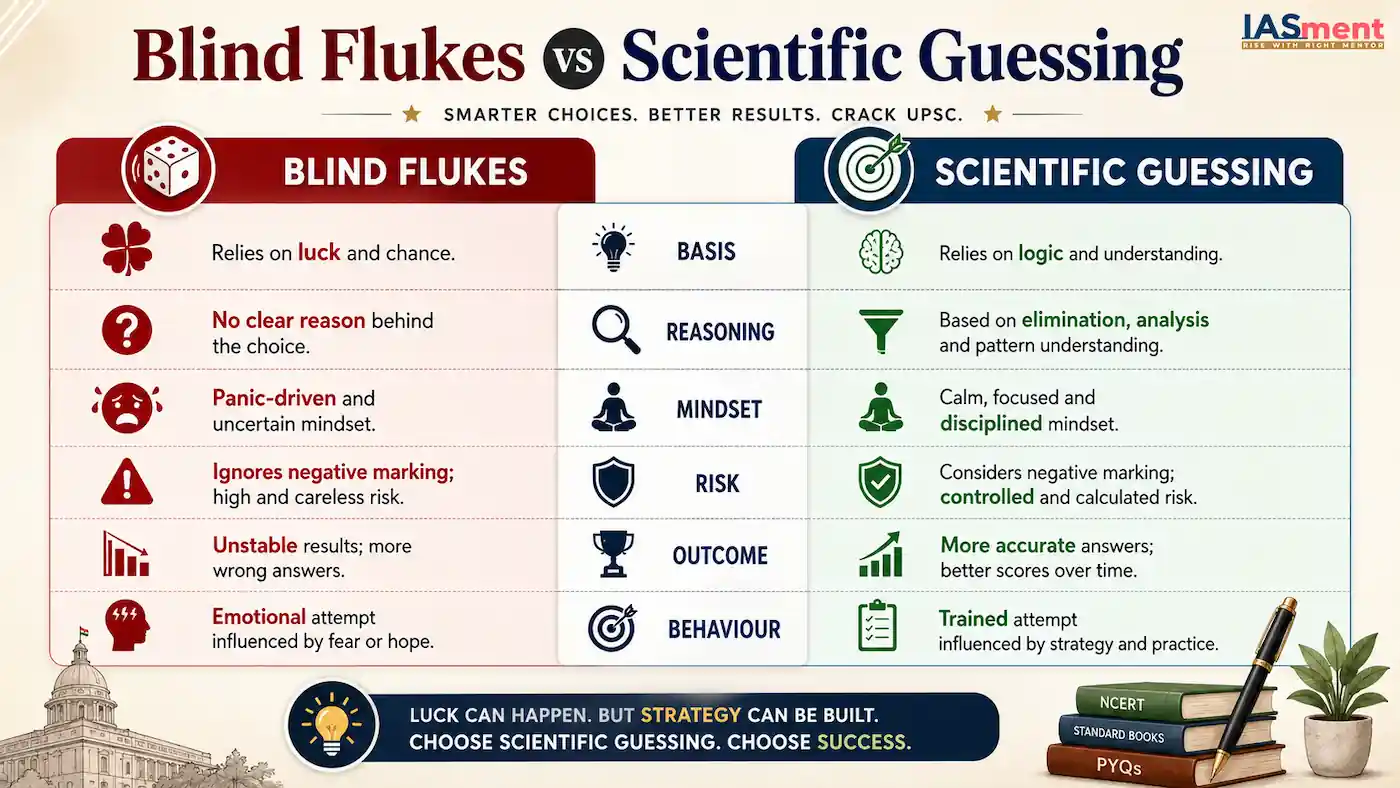
| Blind Fluke | Scientific Guessing |
|---|---|
| Based on luck. | Based on logic and elimination. |
| No clear reason behind the answer. | Clear reason for rejecting wrong options. |
| Driven by panic or overconfidence. | Driven by trained decision-making. |
| Ignores negative marking. | Respects negative marking and risk. |
| Depends on chance. | Depends on technique and subject logic. |
4. Why UPSC Prelims Makes Scientific Guessing Necessary
UPSC Prelims questions are not always direct.
Many questions contain:
- Half-true statements.
- Extreme words.
- Wrong authority names.
- Fake causation.
- Reversed chronology.
- Option mirroring.
- Internal contradiction.
- False alignment between statements.
These are not simple memory checks.
They are traps.
Aspirants who only memorise content often fall into these traps.
Aspirants who are trained in scientific guessing learn how to identify and avoid them.
This is why UPSC Prelims cannot be approached only through reading more books. Students must also learn how UPSC designs MCQs.
5. The Core Rule of Scientific Guessing UPSC Prelims
The core rule is simple:
Before attempting a doubtful question, ask these questions:
- Can I eliminate at least one option with confidence?
- Can I identify one impossible statement?
- Can I detect any extreme or absolute claim?
- Is there an authority-mandate mismatch?
- Is there a wrong chronology?
- Is the statement scientifically or geographically impossible?
- Is the remaining risk acceptable?
If the answer to these questions is yes, the attempt may be scientific.
If the answer is no, the attempt is probably a blind fluke.
6. Technique Example: Polarity Detection
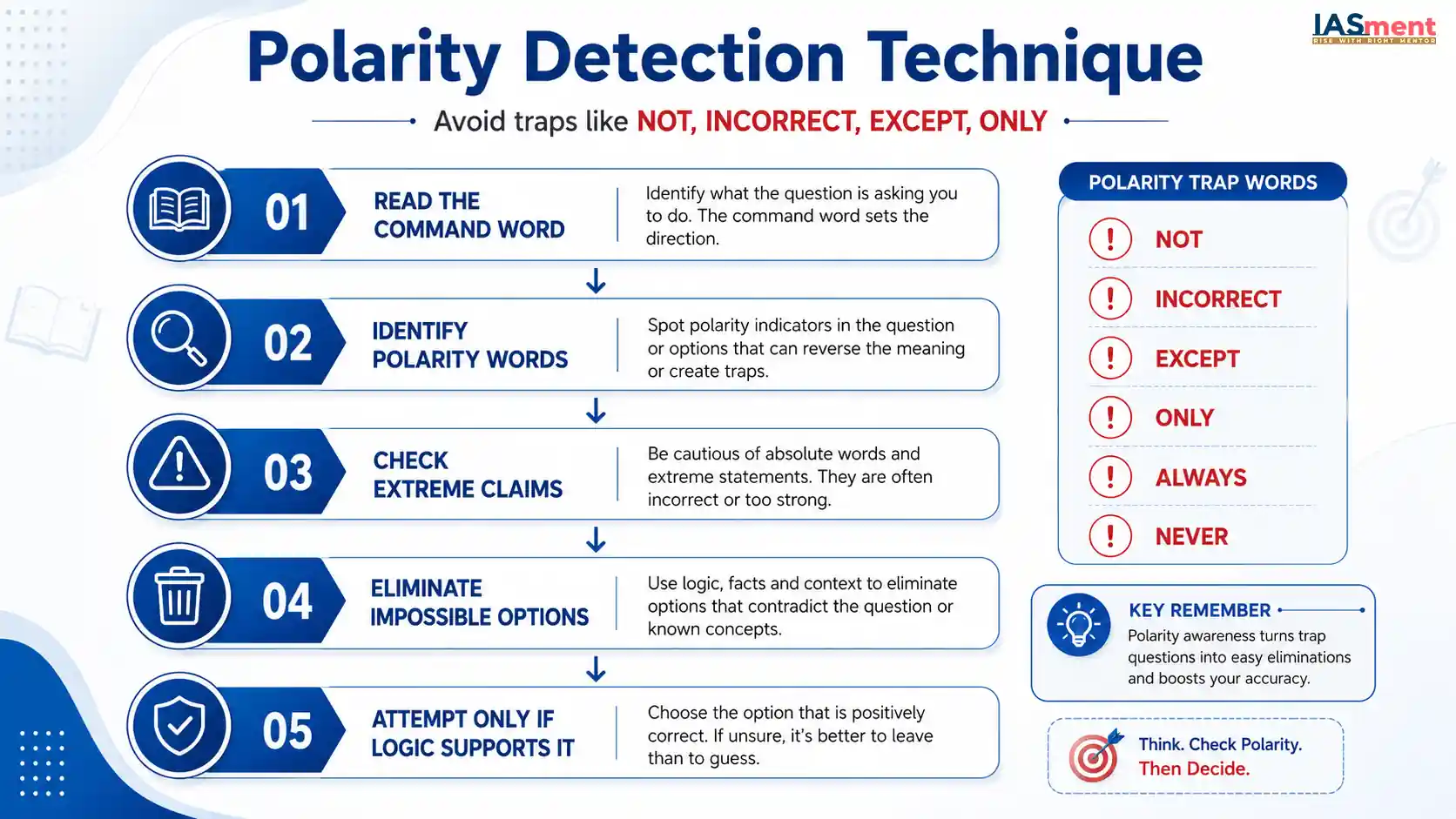
One common technique in Scientific Guessing UPSC Prelims is Polarity Detection.
Polarity Detection means carefully identifying words like:
- Correct
- Incorrect
- Not correct
- Except
- Only
- All
- Never
- Always
Many students lose marks not because they do not know the topic, but because they misread the demand of the question.
Blind guessing ignores polarity.
Scientific guessing reads polarity first, then starts elimination.
This is why the Prelims Techniques Training Lab gives importance to misreading correction, panic control and disciplined MCQ thinking.
7. UPSC-Style Case Study: Scientific Guessing in Action
Let us understand the difference through a UPSC-style question.
Q. Consider the following statements about a government institution:
- It was created to promote private participation in a strategic sector.
- It acts as an authorisation and facilitation body for private entities.
- It has the power to amend the Constitution whenever required for sectoral reforms.
Which of the statements given above is/are correct?
(a) 1 and 2 only
(b) 2 and 3 only
(c) 1 and 3 only
(d) 1, 2 and 3
A student may not know the exact institutional details fully.
But scientific guessing can still help.
Step 1: Detect the Impossible Statement
Statement 3 says that the institution can amend the Constitution.
This is an extreme and constitutionally impossible claim.
No ordinary government institution can amend the Constitution on its own.
Therefore, Statement 3 is incorrect.
Step 2: Eliminate Options Containing Statement 3
Now eliminate options that contain Statement 3.
- Option (b) contains Statement 3.
- Option (c) contains Statement 3.
- Option (d) contains Statement 3.
Only option (a) remains.
Step 3: Understand the Difference
If the student had marked option randomly, it would be a blind fluke.
But here, the student used a logical reason:
- Statement 3 was impossible.
- Options containing Statement 3 were eliminated.
- The answer was reached through logic.
That is Scientific Guessing UPSC Prelims.
8. When Scientific Guessing Should Be Used
Scientific guessing should be used only when there is a logical anchor.
A logical anchor may be:
- One clearly wrong statement.
- One clearly correct statement.
- One impossible claim.
- One extreme word trap.
- One authority-mandate mismatch.
- One chronology error.
- One geography or science impossibility.
- One option pair that can be eliminated.
Scientific guessing is useful when partial knowledge is present.
It is not useful when the question is completely unknown.
9. When You Should Not Guess
A serious aspirant must also know when not to guess.
You should avoid guessing when:
- You cannot eliminate even one option.
- All statements look equally unfamiliar.
- You are attempting only because of fear.
- You are trying to compensate for earlier skipped questions.
- You are emotionally attached to a familiar-looking term.
- You cannot explain your reason for choosing the answer.
If there is no logic behind the attempt, it is not scientific guessing.
It is a blind fluke.
This distinction is very important because UPSC Prelims has negative marking.
10. Why Students Confuse Scientific Guessing with Blind Flukes
Students confuse both because they have never been trained in MCQ decision-making.
Most students are trained only in content.
They are told:
- Read more.
- Revise more.
- Solve more tests.
- Make more notes.
All these are useful.
But they do not automatically teach how to solve UPSC MCQs.
Content helps you study.
Technique helps you clear.
This is the missing layer in many aspirants’ preparation.
Useful Internal Reading:
UPSC Prelims Perfect Attempt: Why 100% Knowledge is Impossible
11. Scientific Guessing UPSC Prelims Needs Exam Behaviour Training
Scientific guessing is not only about logic.
It also needs exam behaviour training.
Aspirants must learn:
- How to choose question order wisely.
- How to recover from doubt loops.
- How to avoid panic-based attempts.
- How to control over-attempting.
- How to avoid under-attempting due to fear.
- How to maintain emotional stability inside the exam hall.
This is why the Prelims Techniques Training Lab includes exam behaviour training, error-correction training and end-to-end Prelims mindset conditioning.
12. The Real Difference: Reason Behind the Attempt
The easiest way to separate scientific guessing from blind flukes is to ask one question:
If the answer is yes, it may be a scientific attempt.
If the answer is no, it is probably a blind guess.
A serious aspirant should be able to say:
- I eliminated this option because it has an extreme claim.
- I rejected this statement because the authority is wrong.
- I avoided this option because it reverses cause and effect.
- I selected this answer because the other options contain impossible statements.
This is the thinking process UPSC aspirants must develop.
13. Why Scientific Guessing Improves Accuracy
Scientific guessing improves accuracy because it reduces emotional decision-making.
It helps students:
- Read questions more carefully.
- Detect hidden traps.
- Eliminate wrong options.
- Control negative marking.
- Attempt with confidence.
- Leave dangerous questions without guilt.
- Use partial knowledge productively.
This is exactly the kind of trained MCQ-solving mind required for modern UPSC Prelims.
14. Final Lesson: Scientific Guessing is a Skill
Scientific Guessing UPSC Prelims is not luck.
It is not shortcut preparation.
It is not random marking.
It is a skill built through:
- Universal MCQ techniques.
- Subject-specific trap identification.
- PYQ-based technique extraction.
- Technique-based simulation tests.
- Error-correction training.
- Exam psychology training.
- Attempt-or-leave discipline.
15. Learn Scientific Guessing in Prelims Techniques Training Lab
At IASment, Aayush Sir teaches UPSC Prelims as a scientific MCQ-solving system.
The Prelims Techniques Training Lab is designed to help students learn:
- 50+ universal scientific MCQ-solving techniques.
- 500+ subject-specific UPSC trap patterns.
- Trap-identification logic.
- Elimination strategy.
- Polarity detection.
- Question engineering analysis.
- Exam psychology and decision-making.
- Error-correction and negative marking control.
This is not another content course.
This is the missing layer of UPSC Prelims preparation.
Stop Blind Flukes. Start Scientific Guessing.
If you want to stop depending on random guessing and start solving UPSC Prelims questions with logic, elimination and confidence, this is the training you need.
Join the Prelims Techniques Training Lab and learn how to decode UPSC Prelims MCQs scientifically.
Join Prelims Techniques Training LabUseful External Resources:
Image Alt Text Checklist: Use “Scientific Guessing UPSC Prelims” or close variations in all image alt text for better SEO relevance.