
The 40-40-20 Rule for UPSC Prelims Time Management
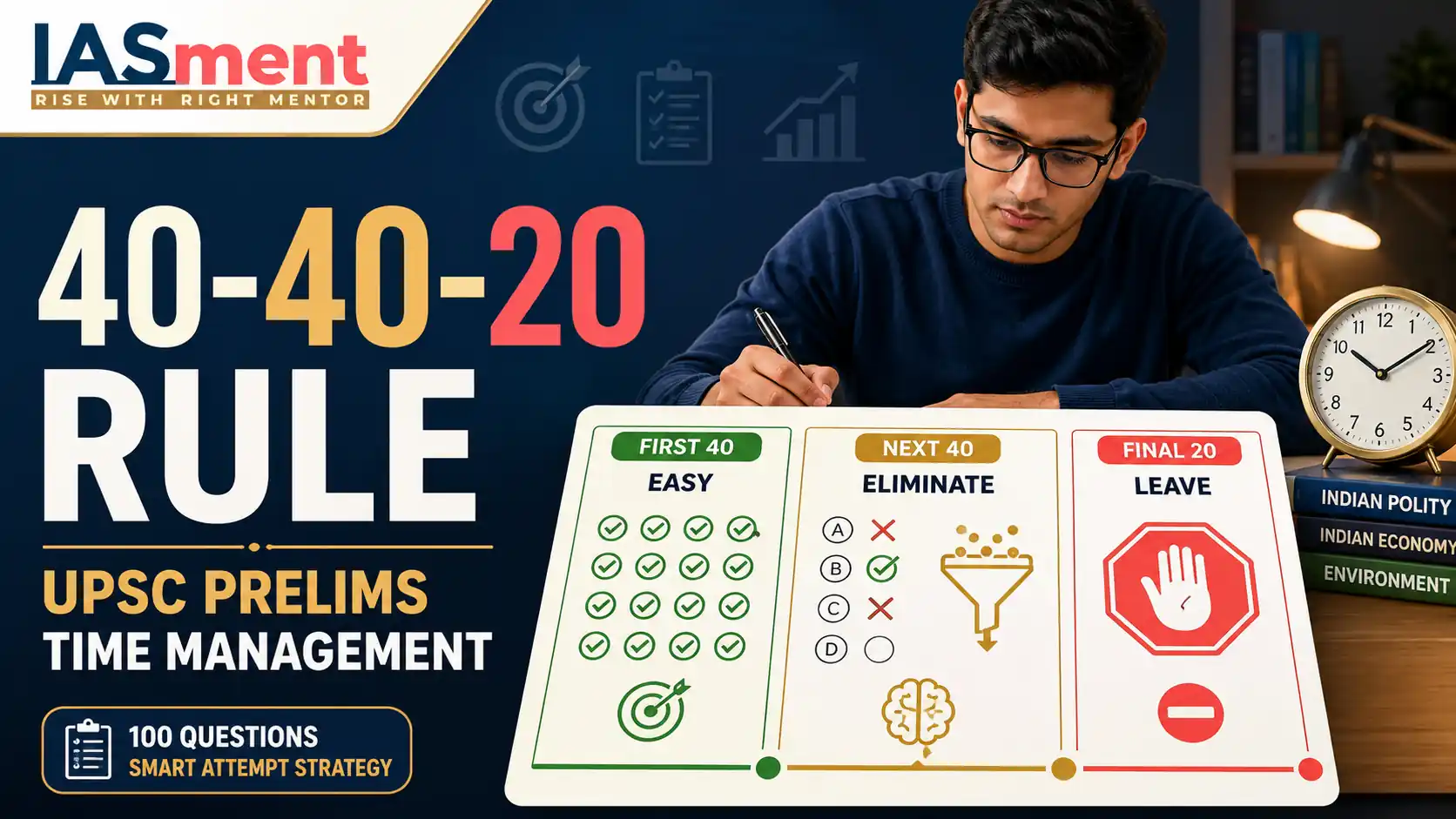
40-40-20 Rule for UPSC Prelims Time Management is a practical exam-hall framework that helps aspirants divide the paper into three categories: easy questions, elimination-based questions and dangerous questions.
The biggest mistake many students make in UPSC Prelims is treating all 100 questions equally. They spend too much time on glamorous, difficult, test-series-type questions and lose marks in the questions they should have solved easily.
The real Prelims strategy is simple: first secure the easy questions, then apply scientific elimination on moderate questions, and finally leave the questions that are designed to waste your time and damage your score.
This is where the 40-40-20 rule becomes useful.
Table of Contents
- What Is the 40-40-20 Rule?
- First 40 Questions: Easy and Basic Questions
- Next 40 Questions: Elimination-Based Questions
- Final 20 Questions: Dangerous Questions to Leave
- Why Students Fail Despite Studying Hard
- Wrong Time Management vs Scientific Time Management
- Scientific Technique: Three-Bucket Attempt Strategy
- How to Prioritise Study Time Subject-Wise
- PYQ/PYQ-Style Case Study
- Useful Resources for Aspirants
- Conclusion
- Prelims Techniques Training Lab
1. What Is the 40-40-20 Rule?
The 40-40-20 rule is a simple way to understand UPSC Prelims time management and attempt strategy.
- First 40 questions: Easy, basic and straightforward questions. These should be solved with maximum accuracy.
- Next 40 questions: Moderate questions where elimination, partial knowledge and option scanning can help.
- Final 20 questions: Difficult, risky or bouncer questions that should generally be left unless there is strong evidence.
This does not mean that the first 40 questions will literally appear from Q1 to Q40. The 40-40-20 rule means that inside the 100-question paper, roughly three types of questions exist.
The trained student identifies them during the exam.
The untrained student fights every question equally.
Core message: UPSC Prelims is not only about knowledge. It is also about question selection, time discipline and negative-marking control.
2. First 40 Questions: Easy and Basic Questions
The first category contains easy, direct and basic questions. These questions usually come from standard sources, repeated themes, basic concepts, common facts, familiar institutions, important schemes, standard geography, core polity, basic economy, environment fundamentals and high-yield current affairs.
These are the questions that serious aspirants should not miss.
Target for First 40
- Read calmly.
- Do not overthink.
- Do not create unnecessary doubt.
- Mark the answer if the concept is clear.
- Aim for near-perfect accuracy.
If a student makes mistakes in this category, the problem is not UPSC unpredictability. The problem is usually poor revision, careless reading, misreading of polarity words or lack of basic conceptual clarity.
Common mistake: Students sometimes lose easy questions because they are psychologically disturbed by the difficult questions around them.
This is why the first rule of Prelims time management is: protect the easy questions.
3. Next 40 Questions: Elimination-Based Questions
The second category contains questions where the answer may not be directly known, but scientific elimination can help.
These are not blind guesses.
These are questions where the student can use:
- Partial knowledge.
- Polarity detection.
- Option scanning.
- Authority-mandate mapping.
- Cause-effect logic.
- Extreme word filtering.
- Internal contradiction detection.
- Pair-based elimination.
- Current-static linkage.
- Subject behaviour understanding.
Important: Even if a student gets only around 40% of these elimination-based questions correct, the overall score can still remain competitive if the first 40 questions are handled with high accuracy.
This is why elimination is not random guessing. It is risk-controlled decision-making.
In many UPSC questions, the student may not know every statement. But if two options can be removed safely, the question becomes attempt-worthy.
4. Final 20 Questions: Dangerous Questions to Leave
The final category contains difficult questions. These may be obscure, overly factual, unfamiliar, trap-heavy or impossible to eliminate safely.
These are the questions that create panic.
But a trained aspirant does not panic. A trained aspirant classifies.
Danger Signals in Final 20 Questions
- No statement is confidently known.
- No option can be safely eliminated.
- The question is purely obscure factual.
- The student is relying only on vague familiarity.
- Two options look equally attractive without evidence.
- The question is consuming too much time.
- The answer is being forced due to ego.
Such questions should generally be left.
Leaving a dangerous question is not weakness. It is score protection.
In UPSC Prelims, the question you leave can sometimes save more marks than the question you attempt.
5. Why Students Fail Despite Studying Hard
Many students fail not because they did not study. They fail because they manage the paper incorrectly.
Some common reasons are:
- Over-glamorising the exam: Students make UPSC appear more mysterious than it actually is.
- Ignoring basic questions: They chase difficult questions but lose marks in simple ones.
- Focusing too much on tough test-series questions: They train fear instead of accuracy.
- Making the process too complicated: They collect too many sources and strategies.
- Attempting emotionally: They mark answers because they have seen the word somewhere.
- Ignoring negative marking: They believe more attempts automatically mean higher marks.
- No attempt-or-leave discipline: They do not know which questions to leave.
Reality check: The cut-off is often built around the easier and moderate questions, not around the most difficult questions in the paper.
This is why the 40-40-20 Rule for UPSC Prelims Time Management is so important. It shifts the student’s attention from “How do I solve everything?” to “How do I maximise marks safely?”
6. Wrong Time Management vs Scientific Time Management
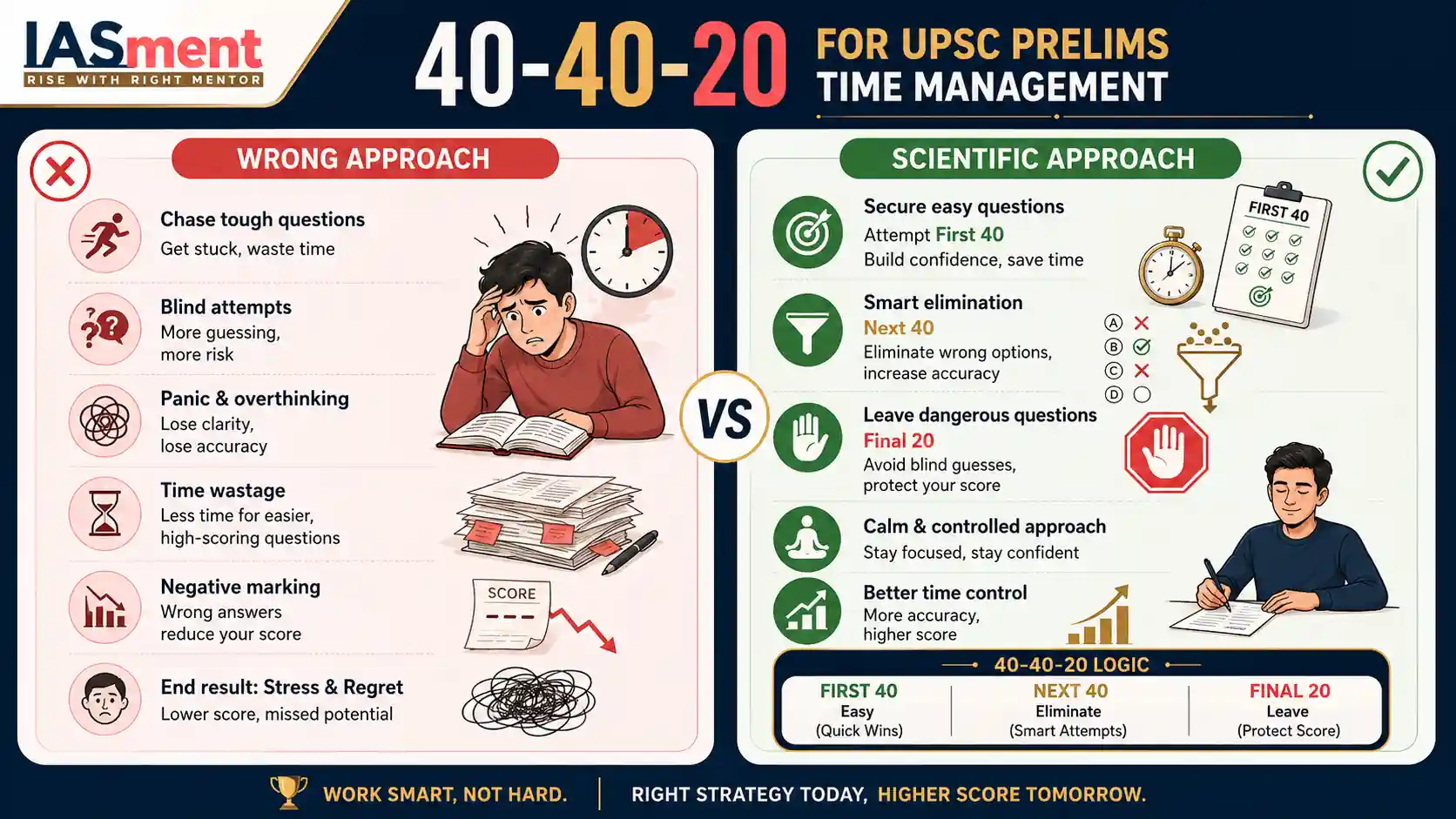
| Wrong Time Management | Scientific Time Management |
|---|---|
| Starts solving question by question without classification | Classifies questions as easy, elimination-based or leave-worthy |
| Spends too much time on bouncers | Secures easy questions first |
| Attempts because of vague familiarity | Attempts only when knowledge or elimination supports the answer |
| Panics after seeing difficult questions | Accepts that 15–20 difficult questions are normal |
| Measures performance by number of attempts | Measures performance by net score and accuracy |
| Uses blind guessing | Uses scientific elimination and risk control |
| Over-glamorises the paper | Uses a calm, practical paper-management system |
7. Scientific Technique: Three-Bucket Attempt Strategy
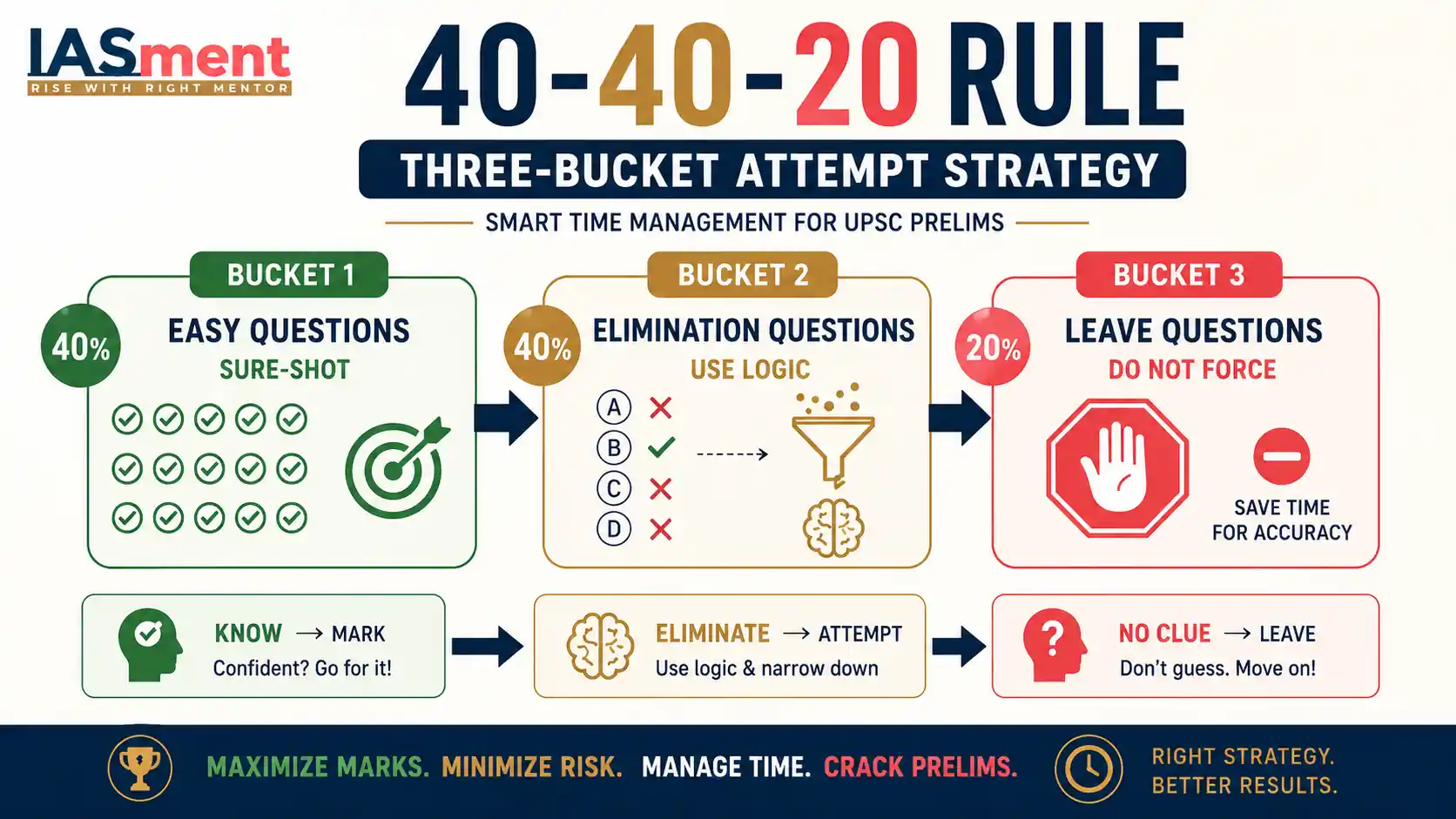
Technique Name: Three-Bucket Attempt Strategy
This technique trains a student to classify questions during the paper instead of reacting emotionally.
- Bucket 1: Sure-shot Questions
These are easy and basic questions. Solve them first and avoid careless mistakes. - Bucket 2: Elimination Questions
These are moderate questions. Attempt only if at least one or two options can be eliminated logically. - Bucket 3: Leave Questions
These are dangerous questions. Leave them if there is no safe elimination, no concept anchor and no confidence.
The purpose of this technique is to reduce negative marking and protect exam-hall confidence.
A student should not decide every question emotionally. A student should decide by evidence.
8. How to Prioritise Study Time Subject-Wise
The speaker’s point about “average questions each year” is extremely important.
Students often waste too much time on areas that give very few questions and ignore subjects that repeatedly contribute a larger share of the paper.
The exact number of questions from each subject may change every year, but the preparation principle remains stable:
Study time should be broadly proportional to:
- Average number of questions from the subject.
- Difficulty level of the subject.
- Your personal weakness in that subject.
- Overlap with current affairs.
- Possibility of elimination through conceptual clarity.
Practical Subject-Time Direction
- Polity: High priority because concepts, institutions, articles, committees, procedures and governance logic regularly appear.
- Economy: High priority because UPSC increasingly tests instruments, digital economy, fiscal-monetary logic and applied concepts.
- Environment: High priority because species, ecosystems, climate, conventions and schemes frequently appear.
- Science and Technology: Increasing priority because the paper often tests application, missions, new technologies and conceptual traps.
- Geography: Stable priority because mapping, physical processes, Indian geography and environmental linkage remain important.
- History and Art-Culture: Selective but important; focus on high-yield areas, chronology, architecture, texts, movements and pair-based traps.
- International Relations: Current-linked preparation is important; focus on organisations, groupings, conventions, locations and India-supported projects.
Simple rule: Do not study emotionally. Study according to paper weightage, your weakness and UPSC’s question-framing style.
9. PYQ/PYQ-Style Case Study
PYQ-style situation:
Consider the following statements about a government programme:
- It is implemented by the correct ministry.
- It aims to improve a clearly defined target group.
- It is legally binding on all States.
Which of the statements given above is/are correct?
How the 40-40-20 rule applies:
- If you know the scheme directly, it is a first-40 type question.
- If you know only the ministry or objective, it may become a next-40 elimination question.
- If you know nothing and cannot verify the legal-status statement, it becomes a final-20 leave question.
The same question can behave differently for different students. That is why UPSC Prelims time management must be personal and evidence-based.
For one student, a question may be easy. For another, it may be elimination-based. For a third, it may be dangerous.
The mature aspirant does not ask, “Is this question easy for everyone?”
The mature aspirant asks, “Is this question safe for me to attempt?”
10. Useful Resources for Aspirants
11. Conclusion
40-40-20 Rule for UPSC Prelims Time Management teaches a very practical lesson: do not fight the entire paper equally.
Secure the first 40 easy and basic questions with high accuracy.
Use elimination and partial knowledge carefully in the next 40 questions.
Leave the final 20 dangerous questions when there is no safe logic, no elimination and no confidence.
This is not a mechanical formula. It is a mindset.
UPSC Prelims is not cleared by glamourising difficulty. It is cleared by staying calm, respecting basics, applying scientific elimination and protecting marks from negative marking.
Aspirants who understand this rule stop behaving emotionally inside the exam hall.
They start behaving like trained decision-makers.

Master UPSC Prelims Scientifically
Aayush Sir from IASment — UPSC Prelims Pattern Decoder and Scientific MCQ Technique Mentor.
The IASment Prelims Techniques Training Lab is not a content course. It is a scientific MCQ-solving, trap-identification, PYQ-decoding, elimination, negative-marking control and exam-hall decision-making system.
- 50+ Universal Scientific MCQ Techniques
- 500+ UPSC Trap Patterns
- Subject-wise MCQ Training Labs
- Multi-format MCQ Solving System
- PYQ Logic Extraction
- Negative Marking Control
- Exam Psychology Training
- Attempt-or-Leave Discipline
- Three-Bucket Attempt Strategy
- UPSC Prelims Time Management Training
Explore The Program