
How to Prepare Current Affairs for UPSC Prelims 2027
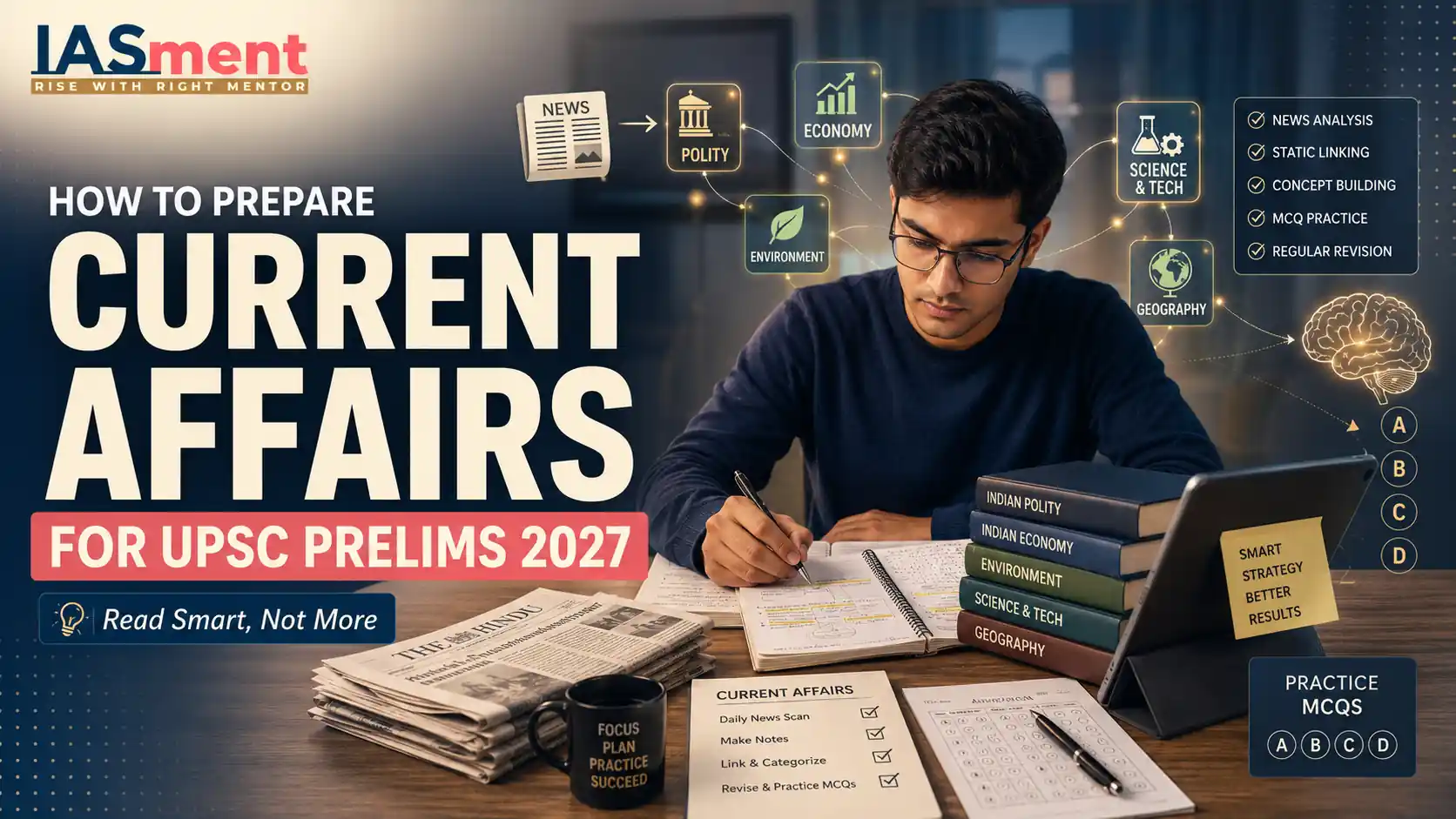
How to Prepare Current Affairs for UPSC Prelims 2027 is now one of the most serious questions for aspirants after the changing nature of the paper.
Many students still think current affairs preparation means reading newspapers, monthly magazines, compilations, schemes, reports, indexes and government announcements endlessly.
But UPSC Prelims does not reward a student merely for collecting more information.
UPSC rewards the student who can connect current affairs with static concepts, identify traps, understand institutional logic, decode statement language, and decide whether a question deserves an attempt or should be left.
This is why current affairs preparation for UPSC Prelims 2027 must become more scientific, more selective and more MCQ-oriented.
Table of Contents
- Why Current Affairs Preparation Has Changed
- The Wrong Way to Prepare Current Affairs
- The Right Way to Prepare Current Affairs for UPSC Prelims 2027
- Comparison: News Reading vs UPSC Current Affairs Preparation
- Scientific Technique: News-to-Static Trap Mapping
- PYQ/PYQ-Style Case Study
- Weekly Current Affairs Preparation System
- Mistakes Students Must Avoid
- Useful Resources for Aspirants
- Conclusion
- Prelims Techniques Training Lab
1. Why Current Affairs Preparation Has Changed
Earlier, many aspirants believed that if they read one newspaper, one monthly magazine and one yearly compilation, current affairs would be handled.
That approach is now incomplete.
The nature of UPSC Prelims has become more layered. Current affairs is no longer asked only as direct factual information. It is increasingly asked through:
- Static linkage.
- Institutional understanding.
- Policy interpretation.
- Application-based reasoning.
- Statement-based traps.
- Close option structures.
- Inference from given information.
- Current-static integration.
Simple meaning: UPSC may use current affairs as the entry point, but the real test may be static understanding, logic, elimination and statement interpretation.
For example, a question may appear to be about climate change, a mission, a summit, a report or a government scheme. But the actual answer may depend on whether the student understands the deeper static concept behind it.
This is where many students fail. They remember the news, but they do not understand the UPSC trap hidden behind the news.
2. The Wrong Way to Prepare Current Affairs
The wrong way is to read every news item with equal seriousness.
This creates three problems:
- The student becomes overloaded.
- The student loses revision capacity.
- The student cannot convert news into MCQ-solving ability.
Dangerous habit: Reading current affairs like a journalist, not like a UPSC aspirant.
A journalist reads news to report what happened.
A UPSC aspirant must read news to understand:
- Why it matters for the syllabus.
- Which static topic is connected.
- Which institution is involved.
- Which constitutional, economic, environmental, scientific or international principle is hidden.
- What kind of statement trap UPSC can create from it.
If a student reads a news item but cannot convert it into a possible MCQ, the preparation is incomplete.
3. The Right Way to Prepare Current Affairs for UPSC Prelims 2027
The right method is not “read more”.
The right method is “connect better”.
Current affairs should be prepared through this formula:
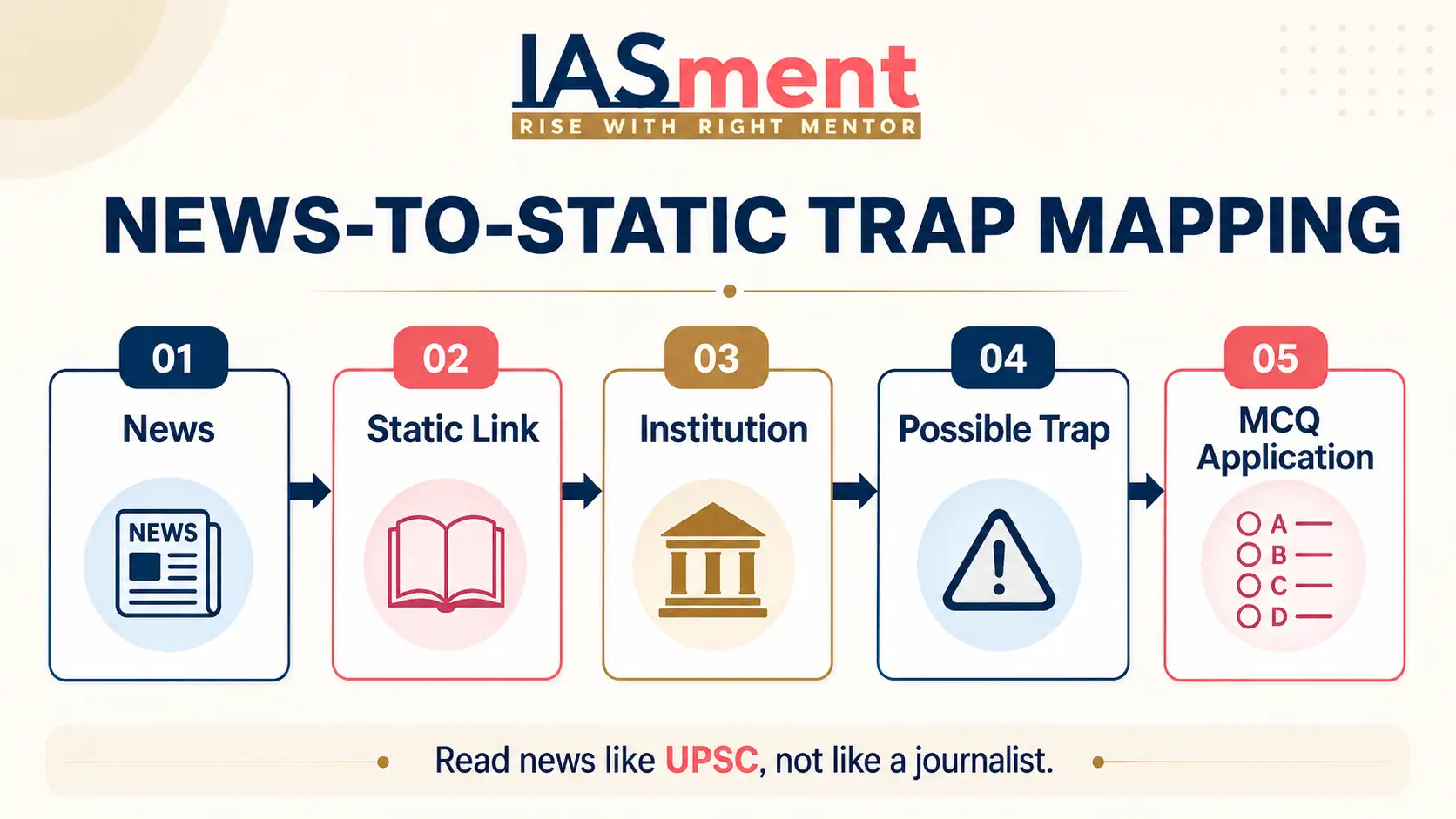
News → Syllabus Link → Static Concept → Institution → Possible UPSC Trap → MCQ Application
Every important current affairs item should be processed through six questions:
- What happened?
- Why is it in news?
- Which syllabus area does it belong to?
- Which static topic is linked with it?
- Which institution, law, convention, report, index, mission or scheme is involved?
- How can UPSC frame a trap from this?
This approach helps the student move from information collection to exam application.
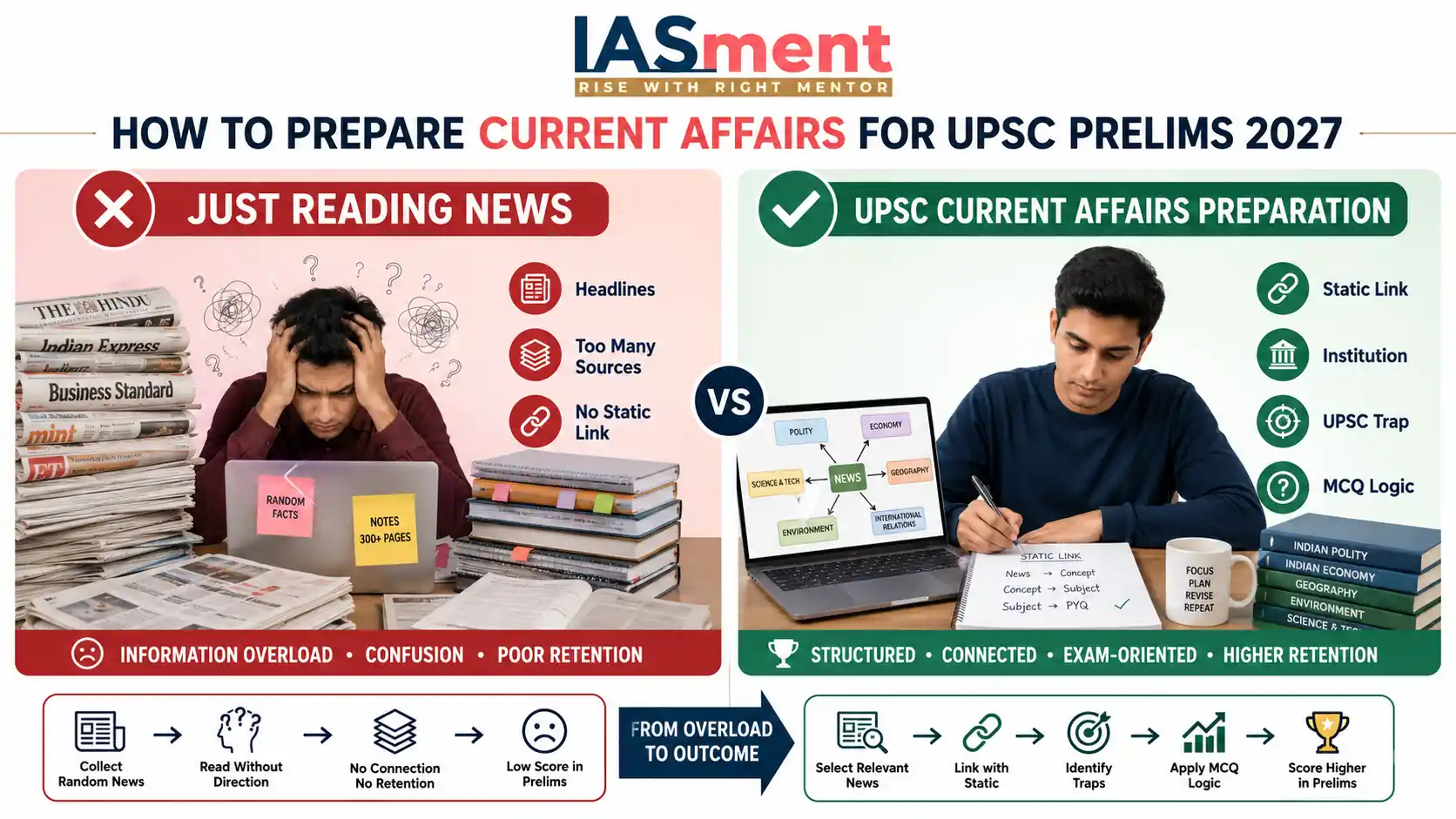
4. Comparison: News Reading vs UPSC Current Affairs Preparation
| Normal News Reading | UPSC Prelims Current Affairs Preparation |
|---|---|
| Reads what happened | Asks why it matters for Prelims |
| Collects facts | Links facts with static concepts |
| Focuses on headlines | Focuses on syllabus relevance |
| Reads political statements | Skips political noise unless syllabus value exists |
| Memorises schemes | Understands objectives, ministry, target group and possible traps |
| Reads reports and indexes blindly | Studies methodology, institution, ranking logic and India-specific relevance |
| Attempts questions emotionally | Uses elimination, polarity control and risk assessment |
5. Scientific Technique: News-to-Static Trap Mapping
Technique Name: News-to-Static Trap Mapping
This is a scientific method to convert current affairs into UPSC Prelims-ready material.
- Identify the news: Pick only syllabus-relevant news.
- Find the static base: Link it with polity, economy, environment, geography, science and technology, history, art and culture, or international relations.
- Identify the institution: Note the ministry, constitutional body, statutory body, international organisation, convention, mission or report-making agency.
- Detect possible traps: Look for authority mismatch, wrong objective, wrong ministry, wrong chronology, exaggerated statement or false cause-effect relation.
- Create MCQ angles: Ask how UPSC can convert this into a statement-based, pair-based, inference-based or elimination-based question.
- Revise through traps: Do not revise only the news; revise the likely trap around the news.
This method trains the mind to see current affairs the way UPSC can frame it.
Do not read the newspaper to collect news. Read it to connect news with static subjects and possible UPSC traps.
6. PYQ/PYQ-Style Case Study
PYQ-style current affairs question pattern:
Consider the following statements about a recent government initiative:
- It is implemented by Ministry X.
- It aims to achieve Objective Y.
- It is legally binding on all States.
Which of the statements given above is/are correct?
How a trained student should think:
- Statement 1 tests institutional mapping.
- Statement 2 tests objective precision.
- Statement 3 may contain an exaggeration or legal-status trap.
- The word “legally binding” should immediately trigger caution.
- The answer should not be guessed emotionally; it should be filtered through authority, mandate and legal status.
This is how current affairs becomes a technique issue, not merely a reading issue.
Many UPSC Prelims questions now use current affairs as a surface layer, while the real answer depends on static clarity, institution mapping, polarity control and elimination.
7. Weekly Current Affairs Preparation System for UPSC Prelims 2027
Students should not allow current affairs to become an endless daily burden.
A practical weekly system is better.
Weekly System
- Monday to Saturday: Read newspaper or source selectively.
- Daily: Note only syllabus-relevant issues.
- Every alternate day: Add static link and institution link.
- Saturday: Convert important news into possible MCQ traps.
- Sunday: Revise through short notes and solve current-static MCQs.
For each news item, make a short note in this format:
- Topic: Example — Environment / Economy / Polity / S&T
- Why in News: One line only.
- Static Link: Core concept behind the news.
- Institution: Ministry, body, report, convention or law.
- UPSC Trap: Possible wrong statement.
- MCQ Angle: How the issue can be asked.
Revision rule: Revise current affairs through traps, not through bulky notes.
8. Mistakes Students Must Avoid
Current affairs preparation becomes dangerous when students do the following:
- Reading multiple newspapers without revision.
- Making bulky notes that are never revised.
- Memorising scheme names without ministry, objective and target group.
- Reading political statements without syllabus value.
- Ignoring static concepts behind news.
- Ignoring institutions and legal status.
- Not practising current-static MCQs.
- Not learning how UPSC frames traps.
- Attempting current affairs questions through vague memory.
- Failing to leave low-confidence questions.
Negative marking warning: Current affairs is one of the biggest areas where students over-attempt because of vague familiarity.
Familiarity is not knowledge. Recognition is not accuracy.
If a student has only heard the term but cannot eliminate options scientifically, the question may not be safe to attempt.
9. Useful Resources for Aspirants
10. Conclusion
How to Prepare Current Affairs for UPSC Prelims 2027 should not be answered with “read more magazines” or “follow more sources”.
The real answer is:
- Read selectively.
- Connect every important news with static subjects.
- Understand institutions and legal status.
- Identify possible UPSC traps.
- Practise current-static MCQs.
- Use scientific elimination.
- Control negative marking.
- Leave questions where vague familiarity creates false confidence.
UPSC Prelims current affairs is no longer only about memory.
It is about thinking, linking, filtering and deciding under pressure.
That is why current affairs preparation for UPSC Prelims 2027 must become more scientific.
Master UPSC Prelims Scientifically
Aayush Sir from IASment — UPSC Prelims Pattern Decoder and Scientific MCQ Technique Mentor.
The IASment Prelims Techniques Training Lab is not a content course. It is a scientific MCQ-solving, trap-identification, PYQ-decoding, elimination, negative-marking control and exam-hall decision-making system.
- 50+ Universal Scientific MCQ Techniques
- 500+ UPSC Trap Patterns
- Subject-wise MCQ Training Labs
- Multi-format MCQ Solving System
- PYQ Logic Extraction
- Negative Marking Control
- Exam Psychology Training
- Attempt-or-Leave Discipline
- Current Affairs Trap Identification
Explore The Program