
UPSC Prelims 2027 Master Plan: How Serious Aspirants Should Prepare
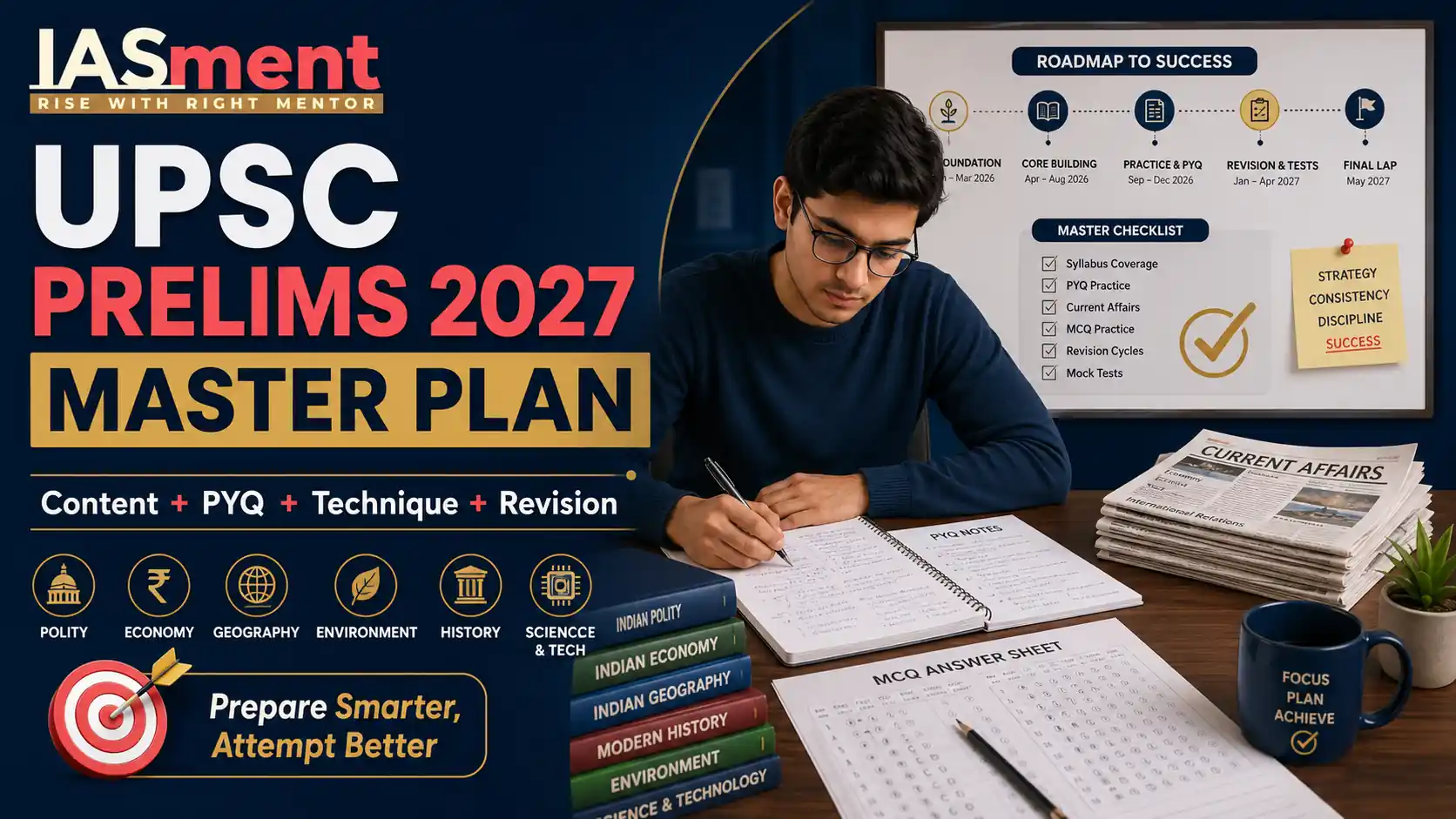
UPSC Prelims 2027 Master Plan cannot be built around the old advice of simply reading more books, solving more tests and collecting more current affairs.
That approach is incomplete because UPSC Prelims is no longer only a test of information. It is also a test of interpretation, elimination, trap identification, subject logic, current-static linkage and decision-making under pressure.
Many sincere aspirants study hard for months, revise repeatedly, solve mocks and still fail to cross the cut-off because they do not train the actual exam-hall skill: how to decode UPSC MCQs scientifically.
This master plan is designed to help aspirants prepare for any type of UPSC Prelims paper: factual, analytical, application-based, inference-based, current-affairs-heavy or mixed.
Table of Contents
- Why UPSC Prelims 2027 Needs a Master Plan
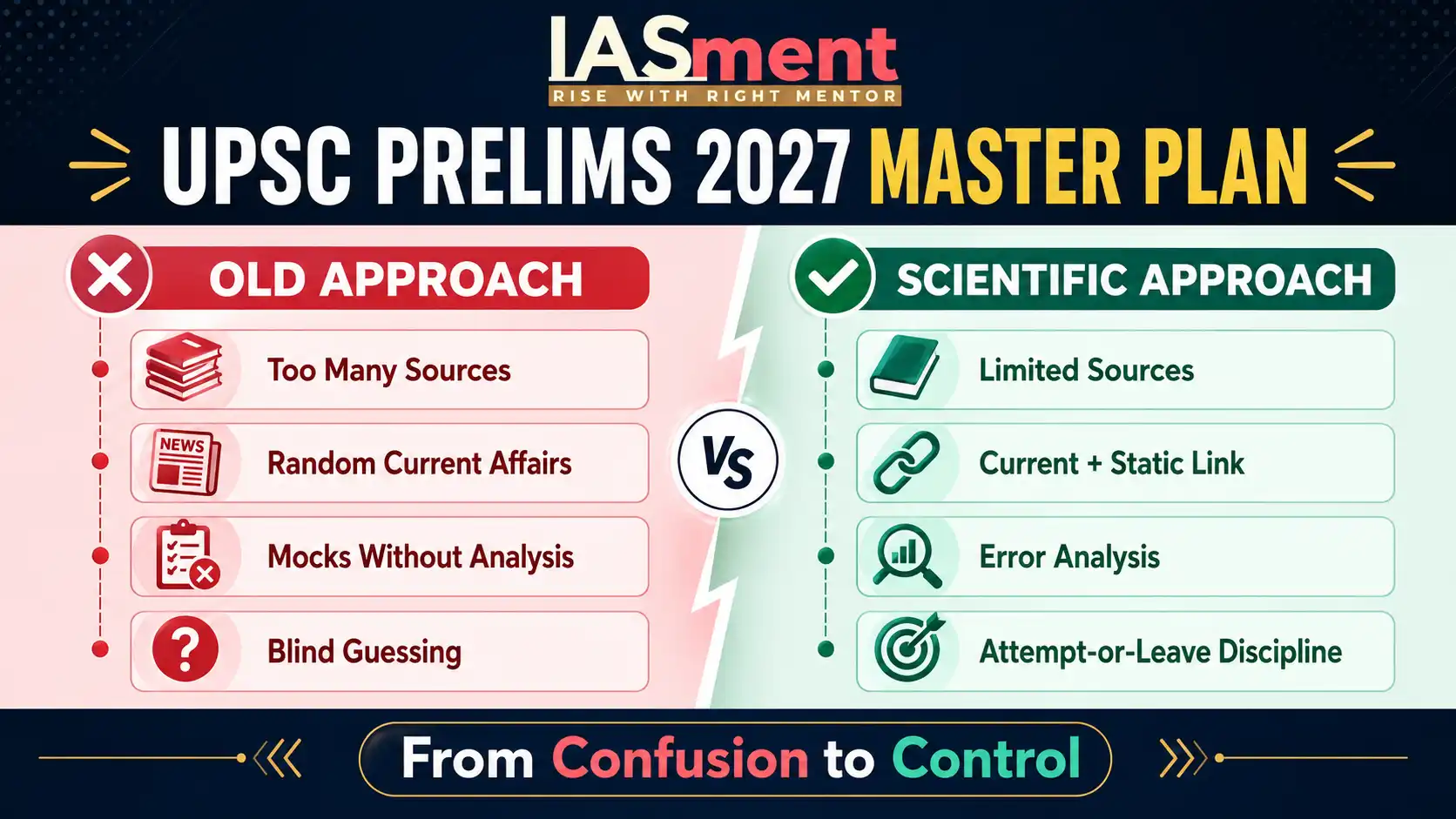
- Old Preparation vs UPSC Prelims 2027 Preparation
- The 9 Pillars of the UPSC Prelims 2027 Master Plan
- Subject-Wise Preparation Direction
- Current Affairs Strategy for Prelims 2027
- Scientific Technique: Three-Layer Prelims Preparation Model
- PYQ/PYQ-Style Case Study
- Monthly Roadmap for UPSC Prelims 2027
- Mistakes Students Must Avoid
- Useful Resources for Aspirants
- Conclusion
- Prelims Techniques Training Lab
1. Why UPSC Prelims 2027 Needs a Master Plan
UPSC Prelims has become unpredictable in presentation, but not completely random in logic.
The paper may ask unusual facts, unfamiliar areas and difficult-looking statements. But the selection is not based on solving every difficult question. Selection is based on crossing the cut-off by maximising correct attempts and controlling negative marking.
Core idea: UPSC Prelims 2027 preparation should not be only about increasing content. It should be about increasing usable content, revisable content and attempt-worthy confidence.
Aspirants must understand that there are three layers in the examination:
- Knowledge layer: What you have studied.
- Question-decoding layer: How you understand what UPSC is really asking.
- Decision-making layer: Whether you should attempt or leave the question.
Most students work only on the first layer. The UPSC Prelims 2027 Master Plan must train all three.
2. Old Preparation vs UPSC Prelims 2027 Preparation
| Old Preparation Mindset | UPSC Prelims 2027 Master Plan Mindset |
|---|---|
| Read more books | Read limited sources deeply and revise repeatedly |
| Collect more current affairs | Connect current affairs with static subjects and traps |
| Solve mocks mechanically | Analyse errors, traps and decision-making behaviour |
| Memorise facts blindly | Understand how facts can be converted into statements |
| Attempt maximum questions | Attempt only questions with knowledge or safe elimination |
| Fear difficult questions | Classify them as attempt-worthy or leave-worthy |
| Depend on motivation | Depend on a repeatable system |
3. The 9 Pillars of the UPSC Prelims 2027 Master Plan
A complete UPSC Prelims 2027 Master Plan should be built on nine pillars.
- Limited source discipline: Avoid source explosion.
- Static subject clarity: Build strong fundamentals in every core subject.
- PYQ decoding: Study how UPSC frames questions, not only what UPSC asks.
- Current-static linkage: Convert news into syllabus-linked concepts.
- Trap notebook: Maintain recurring traps, wrong statements and misleading patterns.
- Scientific MCQ techniques: Learn elimination, polarity control and option scanning.
- Mock-test diagnosis: Analyse wrong attempts, not just scores.
- Revision cycles: Convert knowledge into exam-time recall.
- Attempt-or-leave discipline: Control negative marking scientifically.
These nine pillars together create a stable preparation system. Without them, preparation becomes scattered and emotionally driven.
4. Subject-Wise Preparation Direction
Every subject behaves differently in UPSC Prelims. Therefore, every subject needs a different preparation lens.
Subject-Wise Direction
- Polity: Articles, institutions, procedures, committees, constitutional logic and governance application.
- Economy: Concepts, instruments, institutions, fiscal-monetary logic, financial inclusion, digital economy and current-linked application.
- Environment: Species, ecosystems, conservation logic, climate resilience, protected areas, conventions and schemes.
- Science and Technology: Application, missions, biotechnology, space, defence, AI, quantum, blockchain and conceptual traps.
- Geography: Maps, physical processes, Indian geography, environment linkage and region-form logic.
- History and Art-Culture: chronology, personalities, cultural features, architecture, schools, texts and incorrect pair traps.
- International Relations: organisations, conventions, groupings, locations, India-supported projects and non-binding/binding status.
The mistake students make is preparing all subjects in the same way. UPSC does not frame all subjects in the same way.
For example, Polity may test procedure and authority. Economy may test instruments and cause-effect logic. Environment may test habitat, status and conservation logic. Science and Technology may test application rather than definitions.
5. Current Affairs Strategy for Prelims 2027
Current affairs must not be prepared as a separate mountain of facts.
It must be integrated with static subjects.
Current affairs formula for Prelims 2027:
News → Static Link → Institution → Possible Trap → MCQ Application
For every important news item, ask:
- Which syllabus area does this belong to?
- Which static concept is connected?
- Which ministry, institution, report, law or convention is involved?
- Can UPSC frame a wrong authority trap?
- Can UPSC create an objective mismatch?
- Can UPSC ask it as a statement-based question?
- Can the question be solved through elimination?
This approach prevents current affairs overload and turns news into exam-ready knowledge.
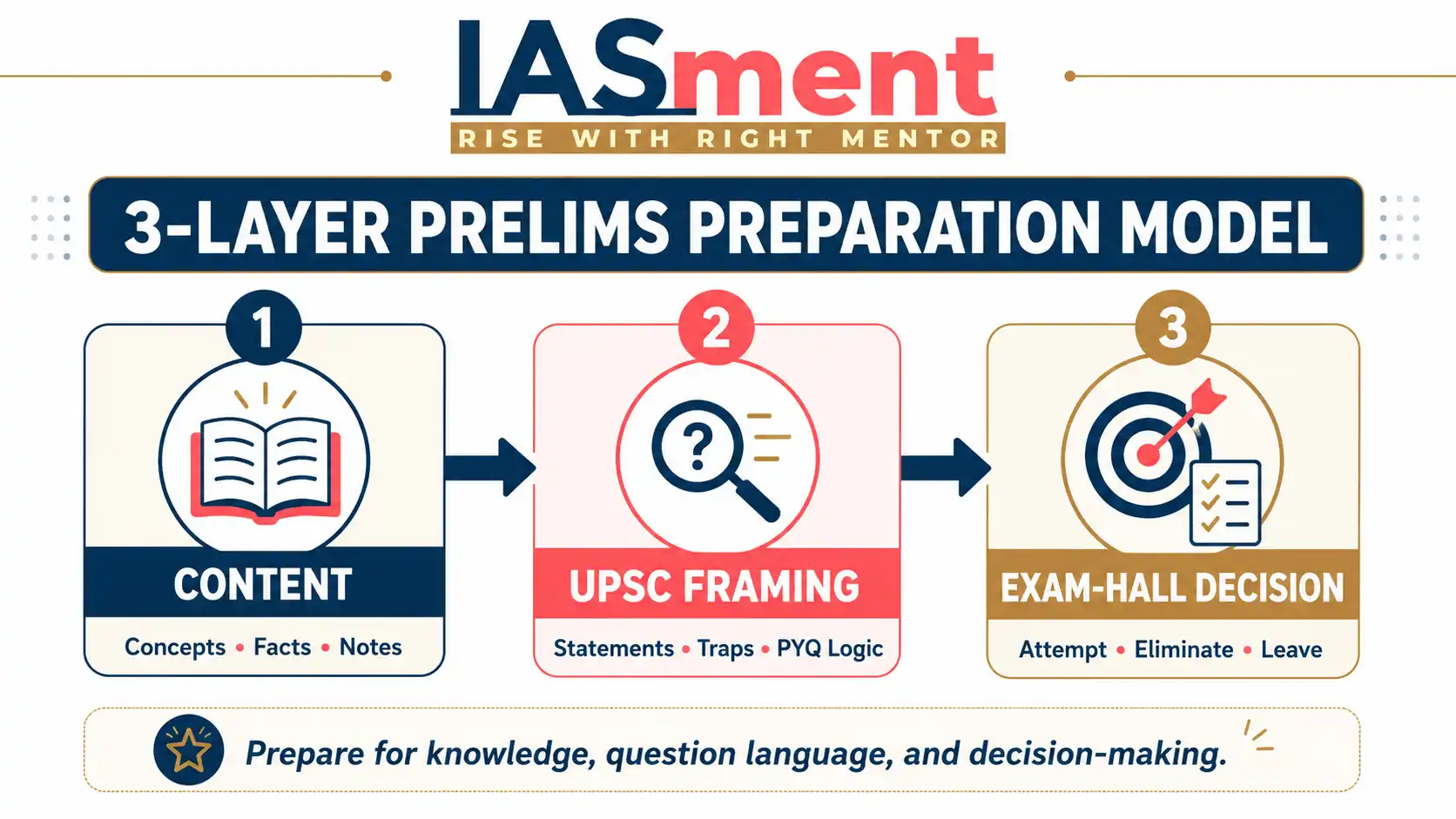
6. Scientific Technique: Three-Layer Prelims Preparation Model
Technique Name: Three-Layer Prelims Preparation Model
This technique helps aspirants prepare every topic in three layers.
- Layer 1: Content
Understand the basic concept, facts, definitions, institutions and examples. - Layer 2: UPSC Framing
Ask how UPSC can convert this topic into a statement, pair, map, chronology, inference or relationship-based question. - Layer 3: Exam-Hall Decision
Train whether to attempt, eliminate, mark for review, or leave the question.
This is the difference between normal study and Prelims-focused study.
Normal study ends with reading. UPSC Prelims preparation begins after reading, when you ask: “How can UPSC trap me here?”
7. PYQ/PYQ-Style Case Study
PYQ-style pattern:
Consider the following statements about a government programme:
- It is implemented by Ministry A.
- It aims to achieve Objective B.
- It is legally binding on all States.
Which of the statements given above is/are correct?
How a trained aspirant thinks:
- Statement 1 tests authority-mandate mapping.
- Statement 2 tests objective precision.
- Statement 3 may contain a legal-status trap.
- The words “legally binding” should immediately trigger caution.
- If only one statement is confirmed, the options must be scanned carefully before attempting.
This is why content alone is not enough.
The student must learn how UPSC hides traps inside ordinary-looking statements.
8. Monthly Roadmap for UPSC Prelims 2027
The UPSC Prelims 2027 Master Plan should be organised in phases.
Phase 1: Foundation Phase
- Complete basic books and class notes.
- Build subject-wise conceptual clarity.
- Begin PYQ reading subject-wise.
- Start current affairs with static linkage.
Phase 2: Consolidation Phase
- Revise each subject at least twice.
- Create short revision sheets.
- Build trap notebooks.
- Practise statement-based MCQs.
Phase 3: Testing Phase
- Take sectional and full-length tests.
- Analyse mistakes deeply.
- Separate knowledge errors from technique errors.
- Track negative marking patterns.
Phase 4: Final Prelims Phase
- Revise only high-yield material.
- Avoid new source explosion.
- Practise exam-hall question selection.
- Train calmness, timing and attempt discipline.
The most important part of this roadmap is not the number of hours studied. It is whether those hours are converting into accuracy, recall and decision-making confidence.
9. Mistakes Students Must Avoid
Even serious aspirants make avoidable mistakes.
- Reading too many sources without revision.
- Ignoring PYQ logic.
- Taking mocks only for marks, not diagnosis.
- Not analysing why wrong answers happen.
- Confusing vague familiarity with knowledge.
- Attempting questions due to ego.
- Leaving questions due to fear even when elimination is possible.
- Not preparing current affairs through static linkage.
- Ignoring polarity words like NOT, incorrect, only, all, always and except.
- Studying content but not studying UPSC question language.
These mistakes create the real gap between preparation and selection.
UPSC Prelims 2027 preparation must therefore be based on clarity, discipline, technique and controlled risk-taking.
10. Useful Resources for Aspirants
11. Conclusion
UPSC Prelims 2027 Master Plan must be practical, scientific and exam-hall oriented.
The student who only reads more may still fail if he or she cannot decode UPSC’s MCQ language.
The student who combines content, revision, PYQ logic, current-static linkage, trap identification, scientific elimination and attempt-or-leave discipline will be better prepared for any type of Prelims paper.
The goal is not to predict the paper.
The goal is to prepare a mind that can handle unpredictability calmly.
This is the real direction for UPSC Prelims 2027.
Master UPSC Prelims Scientifically
Aayush Sir from IASment — UPSC Prelims Pattern Decoder and Scientific MCQ Technique Mentor.
The IASment Prelims Techniques Training Lab is not a content course. It is a scientific MCQ-solving, trap-identification, PYQ-decoding, elimination, negative-marking control and exam-hall decision-making system.
- 50+ Universal Scientific MCQ Techniques
- 500+ UPSC Trap Patterns
- Subject-wise MCQ Training Labs
- Multi-format MCQ Solving System
- PYQ Logic Extraction
- Negative Marking Control
- Exam Psychology Training
- Attempt-or-Leave Discipline
- Current Affairs Trap Identification
- Prelims 2027 Exam-Hall Decision Training
Explore The Program