
How to Approach "Bouncer" Questions in the UPSC Prelims Paper

How to Approach Bouncer Questions in UPSC Prelims is one of the most important skills for clearing the examination.
Every year, UPSC deliberately inserts questions that surprise almost everyone in the examination hall. These are commonly called "bouncer questions".
The biggest mistake students make is treating these questions as if they are supposed to solve all of them. In reality, many such questions test judgement, discipline, elimination ability, risk control and emotional stability.
The real competition is not about answering every question. It is about protecting your score.
Table of Contents
- What Exactly Is a Bouncer Question?
- Why Students Panic During Bouncer Questions
- The Biggest Myth About UPSC Prelims
- The Scientific Bouncer Classification System
- Scientific Technique: The Partial Knowledge Filter
- UPSC 2026 and the Rise of Bouncer Questions
- The Attempt-or-Leave Discipline
- What Students Should Actually Train
- Useful Resources for Aspirants
- Conclusion
- Prelims Techniques Training Lab
1. What Exactly Is a Bouncer Question?
A bouncer question is a question that creates immediate shock because:
- The topic appears unfamiliar.
- The statements look strange.
- The options appear extremely close.
- The question demands inference rather than direct memory.
- The examiner intentionally hides the answer behind confusing wording.
Important: A bouncer question is not necessarily impossible.
It only feels difficult because it breaks the student's expectations.
The UPSC Prelims paper increasingly contains questions where relationships, inference, application and logic matter more than direct recall. Many candidates call these questions random, but a trained student first checks whether the question can be handled through elimination and risk control.
2. Why Students Panic During Bouncer Questions
Most aspirants panic because they enter the exam hall with a content-only mindset. They believe that if they do not know the fact directly, they have already lost the question.
That is not always true.
In UPSC Prelims, there are three different situations:
- You know the answer directly.
- You do not know the answer, but you can eliminate options scientifically.
- You neither know the answer nor have safe elimination.
The problem begins when students treat all three situations in the same way.
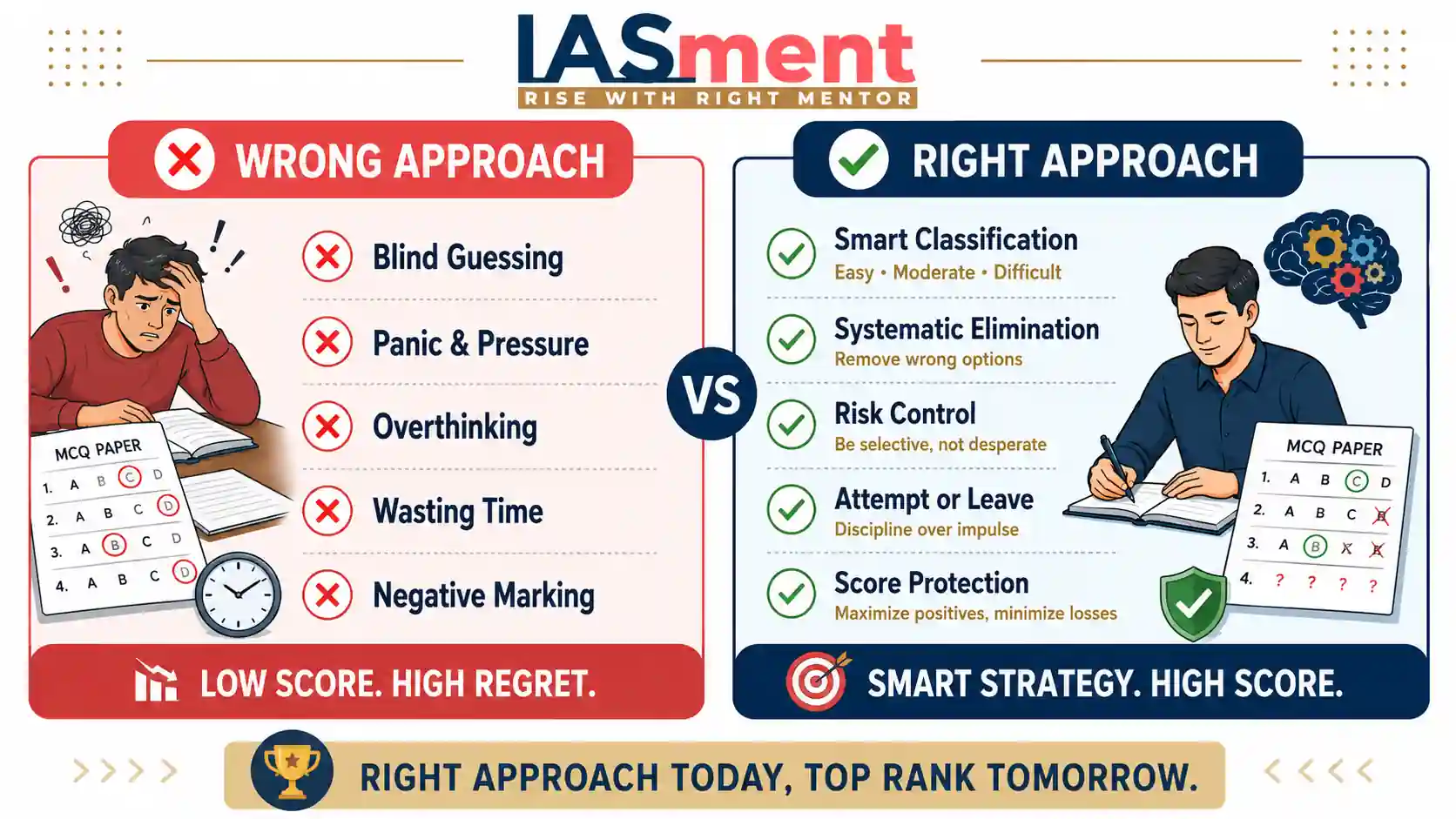
| Wrong Reaction | Result |
|---|---|
| Trying to force an answer | Negative marking |
| Emotional guessing | Score collapse |
| Spending too much time | Easy questions get missed |
| Losing confidence | Poor decisions in later questions |
| Blind elimination | Random outcome, not scientific attempt |
3. The Biggest Myth About UPSC Prelims
"You must solve every difficult question."
This is one of the most damaging beliefs in UPSC preparation.
Cut-off is not determined by solving every question. It is determined by scoring more than the majority of candidates.
When a question is genuinely difficult, it is difficult for thousands of aspirants simultaneously. In such questions, the intelligent strategy is not ego-driven attempting. The intelligent strategy is score protection.
Simple rule: A difficult question should be attempted only when elimination gives you a meaningful advantage.
If a question gives no clue, no logical anchor, no polarity signal and no option-level elimination, then leaving it is not weakness. It is mature exam-hall decision-making.
4. The Scientific Bouncer Classification System
Before attempting a difficult question, classify it.
- Type A: Known Question — You know the concept and answer directly.
- Type B: Partial Knowledge Question — You know one or two statements, but not everything.
- Type C: Elimination Possible Question — Even without full knowledge, two options can be removed.
- Type D: Complete Bouncer — No knowledge, no clue, no safe elimination.
The real danger is not Type D questions. The real danger is misclassifying Type D questions as Type C questions.
UPSC trap: Many students convince themselves that they are applying elimination, but actually they are only guessing emotionally.
A trained aspirant does not ask, “Can I somehow mark this?”
A trained aspirant asks, “Do I have enough evidence to take this risk?”
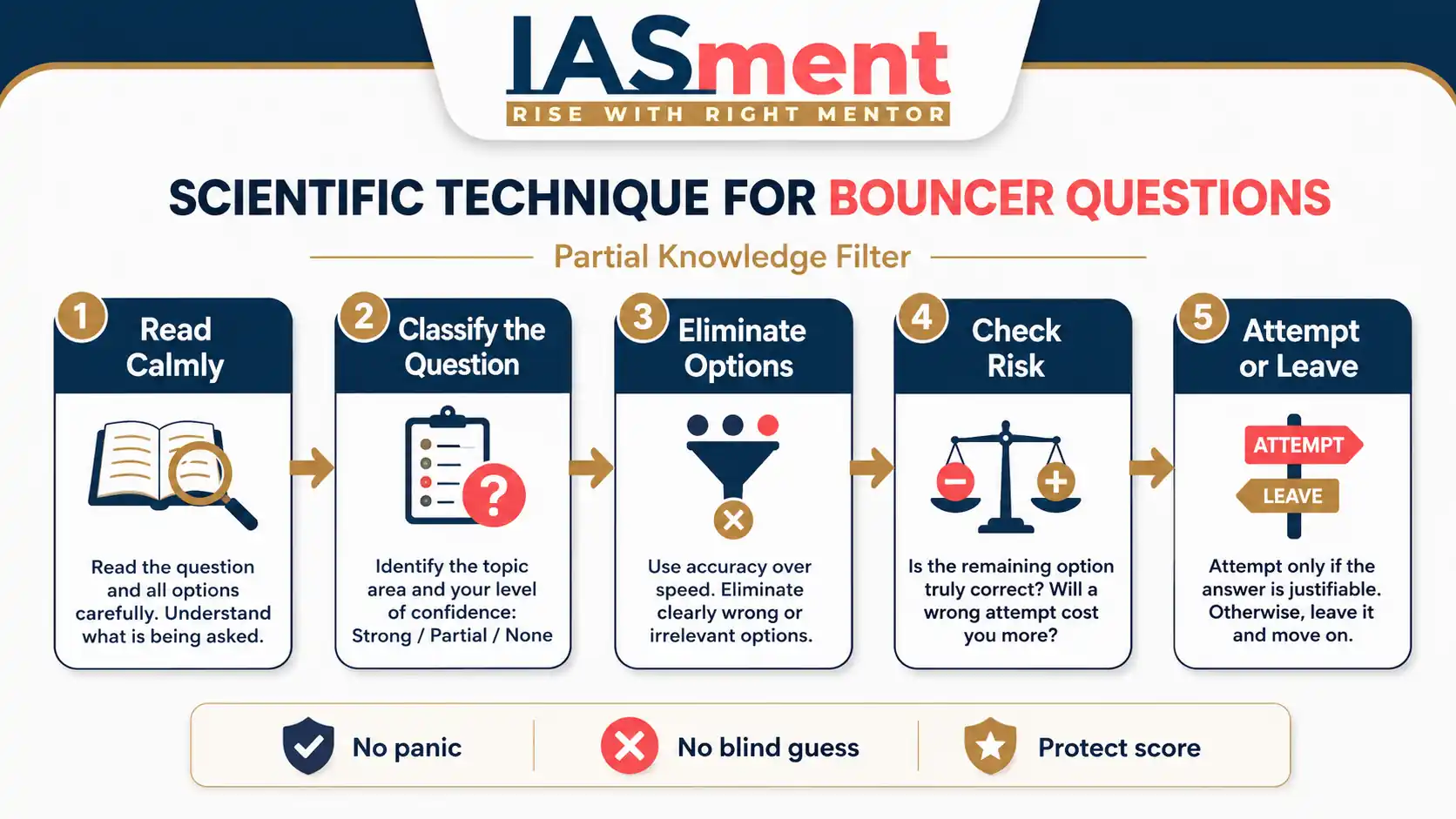
5. Scientific Technique: The Partial Knowledge Filter
Technique Name: Partial Knowledge Management
This technique is used when you do not know the complete answer but have some reliable knowledge about one or two statements, terms, dates, concepts or option pairs.
- Identify known elements: First, mark the part of the question you are genuinely sure about.
- Separate memory from assumption: Do not treat vague familiarity as knowledge.
- Eliminate impossible options: Remove options that contradict your confirmed knowledge.
- Check polarity: Observe words like incorrect, not correct, only, all, always, never and except.
- Look for internal contradiction: Some options or statements may contradict each other logically.
- Assess the final risk: Attempt only if elimination has improved your probability meaningfully.
- Leave if uncertainty remains high: Discipline is also a technique.
This is the difference between scientific guessing and blind flukes.
Scientific guessing is evidence-based. Blind fluke is emotion-based.
The Prelims Techniques Training Lab at IASment trains students in this exact area: trap identification, polarity control, option scanning, negative-marking control, exam behaviour and psychological decision-making.
6. UPSC 2026 and the Rise of Bouncer Questions
The UPSC Prelims 2026 paper showed that the exam is not moving towards simple fact collection. It is moving towards question decoding.
The paper included several questions where candidates had to analyse:
- Inference-based statements.
- Relationship between statements.
- Application of basic concepts.
- Current affairs linked with static logic.
- Close option structures.
- Trap-based wording.
- Statement-level exaggeration or contradiction.
PYQ-style observation:
A student may know only 50–60% of the information in a question. Yet, by understanding statement behaviour and option structure, two options can often be eliminated safely.
Lesson:
The goal is not perfect knowledge. The goal is intelligent decision-making.
This is where Aayush Sir from IASment positions Prelims preparation differently. The issue is no longer only “how much more to read”. The issue is also “how to think inside the paper”.
7. The Attempt-or-Leave Discipline
The strongest UPSC aspirants are not those who attempt the most questions.
They are those who know exactly which questions deserve an attempt.
For a genuine bouncer question, follow this sequence:
- Do not panic.
- Do not force elimination.
- Do not spend excessive time.
- Mark the question for review.
- Move to easier questions first.
- Return later if time permits.
- Attempt only if fresh reading gives a real clue.
- Leave if uncertainty remains high.
Exam-hall truth: Every second spent fighting an unsolvable bouncer may cost you marks in an easy question.
UPSC Prelims is not a bravery contest. It is a marks-management examination.
8. What Students Should Actually Train
Most students train content.
Very few train decision-making.
However, UPSC increasingly rewards:
- Trap identification.
- Polarity control.
- Option scanning.
- Exam psychology.
- Negative-marking management.
- Partial knowledge utilisation.
- Elimination discipline.
- Attempt-or-leave judgement.
- Recovery from panic.
- Question classification under pressure.
This is precisely why IASment positions the Prelims Techniques Training Lab as a technique-training system rather than a traditional content course.
Content helps you study. Technique helps you clear.
9. Useful Resources for Aspirants
10. Conclusion
The real secret behind handling bouncer questions is understanding that they are not always meant to be solved.
Many are designed to test judgement.
Students who remain calm, classify questions correctly, apply scientific elimination, manage risk and respect attempt-or-leave discipline usually outperform those who try to answer everything.
UPSC Prelims is not merely a content examination. It is increasingly becoming an examination of decision-making quality under uncertainty.
This is why a student must not only prepare notes, books and facts. A student must also train the mind to read questions scientifically.
Master UPSC Prelims Scientifically
Aayush Sir from IASment — UPSC Prelims Pattern Decoder and Scientific MCQ Technique Mentor.
The IASment Prelims Techniques Training Lab is not a content course. It is a scientific MCQ-solving, trap-identification, PYQ-decoding, elimination, negative-marking control and exam-hall decision-making system.
- 50+ Universal Scientific MCQ Techniques
- 500+ UPSC Trap Patterns
- Subject-wise MCQ Training Labs
- Multi-format MCQ Solving System
- PYQ Logic Extraction
- Negative Marking Control
- Exam Psychology Training
- Attempt-or-Leave Discipline
- Scientific Elimination Systems
Explore The Program