
UPSC Prelims Perfect Attempt: Why 100% Knowledge is Impossible in UPSC
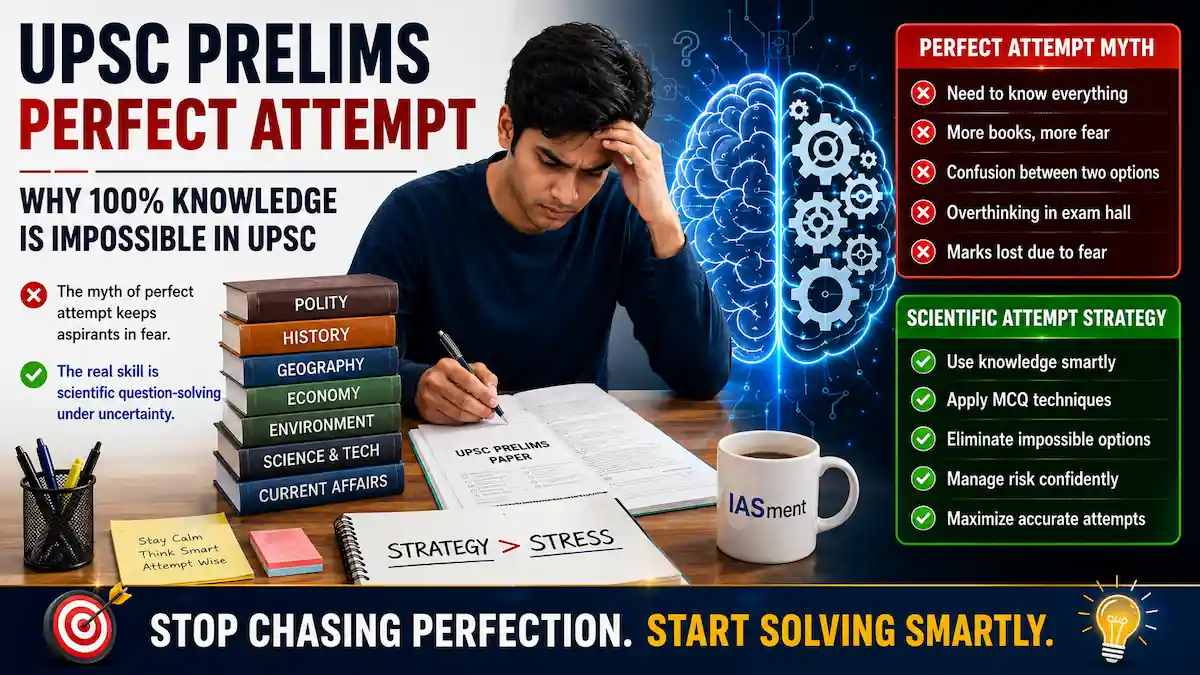
UPSC Prelims Perfect Attempt is one of the most dangerous myths in UPSC preparation.
Many aspirants believe that they can clear Prelims only when they know almost everything. This belief looks sincere, but it silently creates fear, overthinking and poor exam-hall decision-making.
UPSC Prelims is not cleared through 100% knowledge. It is cleared through a combination of knowledge, reasoning, elimination, risk control and exam-hall discipline.
Every year, students keep adding more books, more PDFs, more current affairs compilations and more mock tests. Still, inside the exam hall, the same problem appears.
- Two options look close.
- One statement looks familiar.
- Another statement feels doubtful.
- The student starts thinking, “If only I had studied more.”
- Confidence starts falling during the paper.
But the truth is different.
UPSC Prelims does not demand perfect knowledge. It demands a scientific attempt strategy.
1. What is the UPSC Prelims Perfect Attempt Myth?
The UPSC Prelims Perfect Attempt myth is the belief that an aspirant must know every fact before attempting questions confidently.
This mindset looks serious from the outside. But in reality, it creates fear.
It makes students believe that every unfamiliar question is proof of weak preparation. That is not true.
UPSC Prelims is designed in such a way that even well-prepared aspirants will face uncertain questions.
The real issue is not whether uncertainty will come.
It will definitely come.
The real issue is whether the student knows how to handle uncertainty scientifically.
Aspirants generally suffer from the perfect attempt myth in three ways:
- They think they must complete everything before practising seriously.
- They believe every question should be solved through direct knowledge.
- They assume confusion between two options means poor preparation.
This thinking damages Prelims performance because UPSC does not give perfect certainty in every question.
2. Why the UPSC Prelims Perfect Attempt is Impossible
The UPSC syllabus is vast. But the question style is even wider.
Even if a student reads standard sources sincerely, UPSC can still frame a question in an unfamiliar way.
That does not mean the student has failed. It simply means UPSC is testing application.
UPSC may ask questions through:
- Static concepts.
- Current affairs.
- Reports and institutions.
- Laws and committees.
- Geography and maps.
- Environment and species.
- Science and technology.
- Economy and financial instruments.
- History and culture.
- Administrative logic.
This is why 100% knowledge is practically impossible.
The UPSC Prelims Perfect Attempt is impossible because UPSC does not test memory alone. It tests decision-making under uncertainty.
Aspirants must understand this clearly:
- Unfamiliar questions do not always mean poor preparation.
- Confusion does not always mean lack of knowledge.
- Partial knowledge can still be useful if applied scientifically.
- The exam rewards controlled risk, not blind confidence.
- The paper tests how calmly a student thinks under pressure.
3. The Real Problem: Lack of Technique, Not Always Lack of Knowledge
After a mock test, many students immediately say:
“I need to read more.”
Sometimes this is true. If basic concepts are weak, reading is required.
But many times, the real problem is not lack of study. The real problem is lack of technique.
A student may know the topic but may not know how to apply that knowledge in MCQ form.
For example:
- In Polity, the student may read the Constitution but still miss an authority-mandate trap.
- In Economy, the student may know the topic but confuse instrument and function.
- In Environment, the student may read species names but miss species-habitat mismatch.
- In Current Affairs, the student may remember the news but fail to connect it with static concepts.
- In Science-Tech, the student may know the term but fail to detect an exaggerated scientific claim.
So, the problem is not always content deficiency.
Many times, the problem is application deficiency.
This is why the UPSC Prelims Perfect Attempt mindset is incomplete. UPSC preparation needs reading, but it also needs scientific MCQ-solving.
4. Why “Read More Books” is Not Enough
The traditional advice given to students is very simple:
“Read more.”
This advice is not completely wrong. Reading is necessary.
But after a point, more reading does not automatically improve Prelims marks.
Many students read more but still make the same mistakes.
- They get confused between two options.
- They attempt emotionally.
- They fear negative marking.
- They leave doable questions.
- They mark dangerous questions because the topic looks familiar.
- They change answers at the last moment due to panic.
This happens because UPSC Prelims is not only a content exam.
It is a content + technique exam.
The UPSC Prelims Perfect Attempt myth pushes aspirants towards endless reading. But the actual need is scientific question-decoding.
Useful Internal Reading:
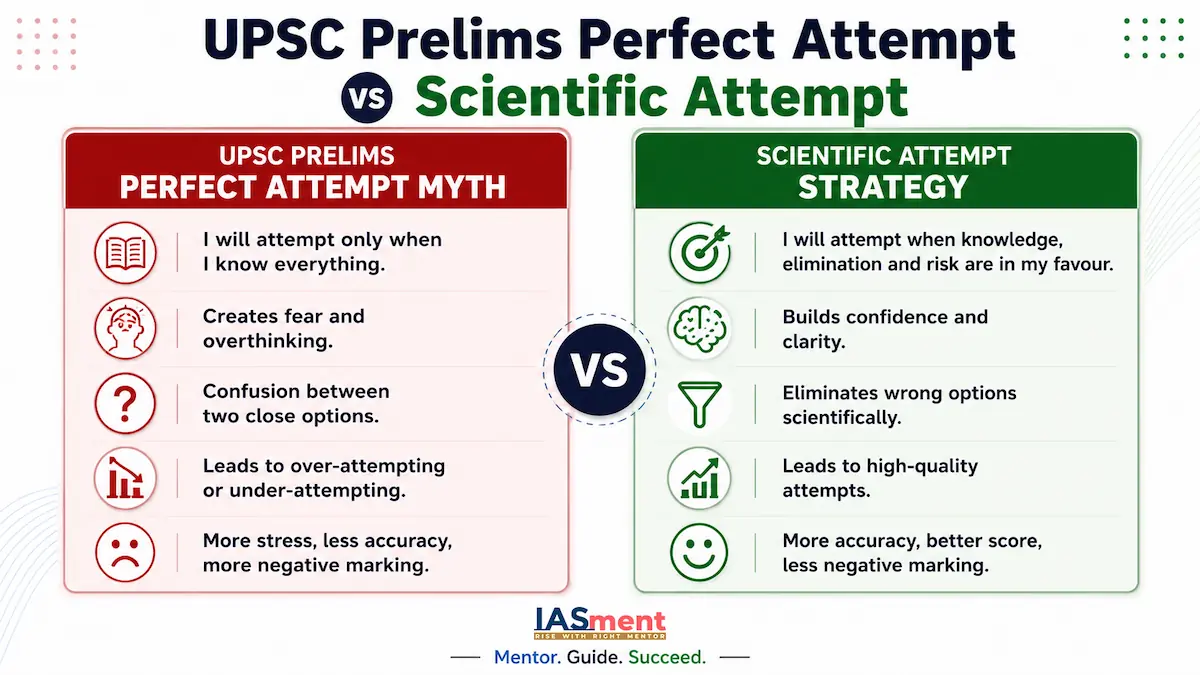
5. UPSC Prelims Perfect Attempt vs Scientific Attempt
A perfect attempt mindset says:
“I will attempt only when I know everything.”
A scientific attempt mindset says:
“I will attempt when knowledge, elimination and risk are in my favour.”
This difference is very important.
A scientific attempt is not random guessing. It is not overconfidence. It is not gambling.
It is a structured decision based on seven things:
- What you know.
- What you can eliminate.
- What is logically impossible.
- What is too extreme.
- What is institutionally incorrect.
- What level of risk is acceptable.
- What should be left.
This is the real exam-hall skill.
Aspirants should replace the dream of a perfect attempt with the discipline of a scientific attempt.
6. Scientific MCQ Solving Technique: The Impossibility Filter
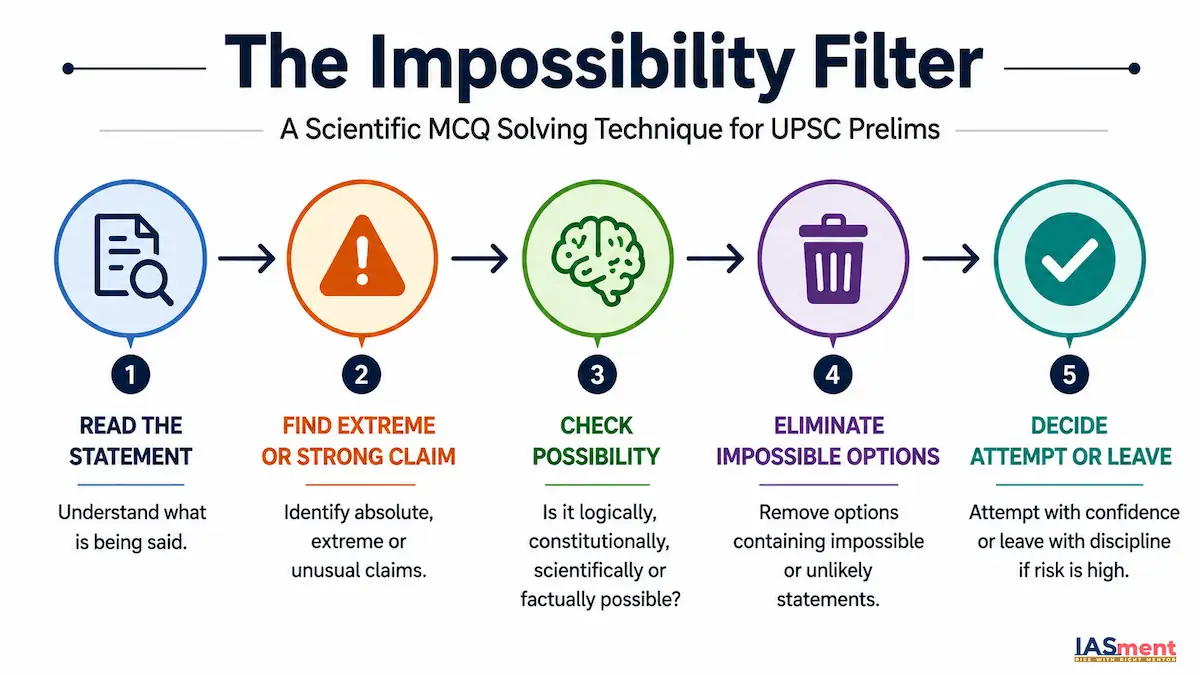
One powerful technique to break the UPSC Prelims Perfect Attempt mindset is the Impossibility Filter.
The Impossibility Filter means checking whether a statement is logically, constitutionally, historically, geographically, institutionally or scientifically impossible.
In UPSC questions, wrong statements are often not completely random. Many wrong statements contain a hidden impossibility.
That impossibility may be based on:
- Wrong constitutional authority.
- Wrong institution-mandate mapping.
- Wrong geography.
- Wrong chronology.
- Wrong cause-effect direction.
- Extreme or absolute claim.
- Scientific impossibility.
- Administrative impossibility.
A normal student asks:
“Have I read this exact fact?”
A trained student asks:
“Can this statement logically be true?”
This shift is extremely important.
It helps students use partial knowledge with maturity.
7. UPSC Prelims Perfect Attempt Case Study: PYQ-Style Example
Let us understand this through a UPSC-style example.
Q. Consider the following statements about a constitutional body:
- It is created directly by the Constitution of India.
- Its members are appointed by the President of India.
- It can amend the Constitution if required for administrative efficiency.
- Its reports may be submitted to the President or the Governor, depending on jurisdiction.
Which of the statements given above are correct?
(a) 1, 2 and 4 only
(b) 1 and 3 only
(c) 2, 3 and 4 only
(d) 1, 2, 3 and 4
At first glance, many aspirants may feel confused. They may not immediately identify the exact constitutional body.
But the question can still be solved scientifically.
This is where the Impossibility Filter helps.
Step 1: Identify the Most Extreme Claim
Statement 3 says:
“It can amend the Constitution if required for administrative efficiency.”
- This is a very strong claim.
- A constitutional body cannot amend the Constitution on its own.
- Constitutional amendment follows a specific procedure under Article 368.
- So, Statement 3 is constitutionally impossible.
- Therefore, Statement 3 is incorrect.
Step 2: Eliminate Options Containing the Impossible Statement
Now check the options:
- Option (a): 1, 2 and 4 only.
- Option (b): 1 and 3 only.
- Option (c): 2, 3 and 4 only.
- Option (d): 1, 2, 3 and 4.
Options (b), (c), and (d) contain Statement 3.
- So, these options are eliminated.
- Only option (a) remains.
8. What This Example Teaches About the UPSC Prelims Perfect Attempt
This example teaches one powerful lesson:
The student did not need 100% knowledge.
The student needed:
- Constitutional common sense.
- Ability to identify an impossible statement.
- Calm option elimination.
- Confidence to reject attractive wrong options.
- Discipline to avoid random guessing.
This is the difference between blind guessing and scientific elimination.
| Blind Guessing | Scientific Elimination |
|---|---|
| “I do not know, so I will mark anything.” | “I may not know everything, but I can identify what cannot be true.” |
That is the real Prelims skill.
The UPSC Prelims Perfect Attempt myth says that everything must be known directly. But UPSC often rewards students who can reason correctly even with limited information.
9. Why Negative Marking Destroys the Perfect Attempt Mindset
UPSC Prelims has negative marking.
This means every wrong answer has a cost.
Therefore, the goal is not to attempt the maximum number of questions. The goal is to make high-quality attempts.
The UPSC Prelims Perfect Attempt mindset creates two dangerous behaviours:
- Some students attempt too little because they are never fully sure.
- Some students attempt too much because they panic.
Both approaches are risky.
The mature approach is controlled risk.
A controlled-risk approach means:
- Attempt when direct knowledge is strong.
- Attempt when elimination is strong.
- Attempt when one or more statements are clearly impossible.
- Avoid emotional guessing.
- Leave questions where there is no meaningful anchor.
- Protect marks from negative marking.
Useful External Resources:
10. The Real Skill: Partial Knowledge Management
In UPSC Prelims, questions usually fall into four categories.
- Direct knowledge questions.
- Elimination-based questions.
- Partial knowledge questions.
- No-clue questions.
A beginner treats all uncertain questions similarly.
A trained aspirant separates uncertainty into levels.
They ask:
- Can I eliminate one statement?
- Can I identify an impossible claim?
- Is there an authority-mandate mismatch?
- Is the statement too absolute?
- Is the remaining risk acceptable?
- Should I attempt or leave?
This is called partial knowledge management.
Aspirants who clear Prelims are not those who know everything. They are those who handle uncertainty better than others.
That is why the UPSC Prelims Perfect Attempt should not be the target.
11. How to Prepare Without Chasing the UPSC Prelims Perfect Attempt
Aspirants should not stop reading.
But they must change the way they read.
While reading any topic, ask these questions:
- What trap can UPSC create from this topic?
- What authority can be wrongly matched?
- What chronology can be reversed?
- What word can be exaggerated?
- What institution can be wrongly linked?
- What current affairs link can be created?
- What statement would look attractive but be wrong?
- What option can UPSC make confusing?
- What is the core concept behind this fact?
- How can this topic be converted into a statement-based question?
This makes preparation exam-oriented.
It also reduces the fear created by the UPSC Prelims Perfect Attempt mindset.
Useful Internal Reading:
12. Use PYQs as Decoding Material
PYQs are not only practice questions.
They are UPSC’s language.
While analysing PYQs, students should observe:
- How UPSC frames wrong statements.
- How UPSC creates close options.
- How UPSC mixes static and current affairs.
- How UPSC tests conceptual clarity.
- How UPSC punishes overconfidence.
- How UPSC rewards calm elimination.
- How UPSC uses extreme words.
- How UPSC creates authority-based traps.
- How UPSC turns simple facts into applied statements.
- How UPSC tests decision-making more than memory.
This is more useful than only checking marks.
PYQ analysis breaks the UPSC Prelims Perfect Attempt illusion. It shows students that UPSC rewards thinking, not just memory.
13. Train Scientific MCQ Techniques
Students must separately train scientific MCQ techniques.
Important techniques include:
- Impossibility Filter.
- Absolute Word Alert.
- Authority–Mandate Mapping.
- Cause–Effect Direction.
- Chronology Anchor.
- Region–Form Logic.
- Pair-Lock Trick.
- Outlier Detection.
- Polarity First.
- Elimination Logic.
These techniques do not replace knowledge.
They make knowledge usable.
They help aspirants convert partial knowledge into marks.
This is why a scientific MCQ-solving system is essential for modern UPSC Prelims preparation.
14. Develop Attempt-or-Leave Discipline
Leaving a question is not weakness.
In UPSC Prelims, leaving a dangerous question is maturity.
A question should be left when:
- You have no conceptual anchor.
- You cannot eliminate even one option.
- The topic is completely unknown.
- The remaining options are equally risky.
- Your attempt is emotional.
- You are marking only because the topic looks familiar.
- You are trying to compensate for previous doubtful questions.
- You are unable to justify the attempt logically.
The goal is not to prove bravery.
The goal is to clear the cut-off.
This is why UPSC Prelims Perfect Attempt should be replaced with scientific attempt discipline.
15. Final Lesson: UPSC Does Not Demand Perfection
UPSC does not demand perfection.
It demands:
- Strong basics.
- Smart revision.
- PYQ decoding.
- Scientific elimination.
- Negative marking control.
- Calm decision-making.
- Partial knowledge management.
- Attempt-or-leave discipline.
Students should not prepare for an imaginary paper where they know everything.
They should prepare for the real paper.
In the real paper:
- They will know some questions directly.
- They will solve some questions through elimination.
- They will handle some questions with partial knowledge.
- They will leave some questions with discipline.
16. Learn the Complete System in Prelims Techniques Training Lab
At IASment, Aayush Sir teaches UPSC Prelims not as a random guessing game, but as a scientific question-decoding system.
The Prelims Techniques Training Lab is designed to train aspirants in:
- Scientific MCQ solving.
- Trap identification.
- PYQ decoding.
- Elimination techniques.
- Attempt-or-leave decision-making.
- Negative marking control.
- Exam-hall behaviour.
- Handling unpredictable Prelims papers.
The Impossibility Filter is only one technique.
Inside the Prelims Techniques Training Lab, students learn 49+ universal techniques that help them approach UPSC Prelims questions with clarity, structure and confidence.
Stop Random Guessing. Start Scientific MCQ Solving.
If you want to stop depending on random guessing and start solving UPSC Prelims questions scientifically, this is the training you need.
Join the Prelims Techniques Training Lab and learn how to decode UPSC Prelims like a serious aspirant — not like a blind guesser.
Join Prelims Techniques Training Lab